Land Area Units Converter and Share Division in Excel: Feddan, Qirat, Sahm, Dunum, Qasaba and Square Metres
- XLSX
- 10 KB
- Version 1.0
- English
- October 23, 2026
Ready to download
Editable Excel file
This sheet is also available in: العربية
One of the most repeated questions in the Arab world: how many metres is this land, and what is each heir’s or partner’s share? The reason is that area units differ from country to country, even within a country: the feddan in Egypt is not the feddan elsewhere, and the dunum in Iraq is not the dunum in Jordan and Palestine.
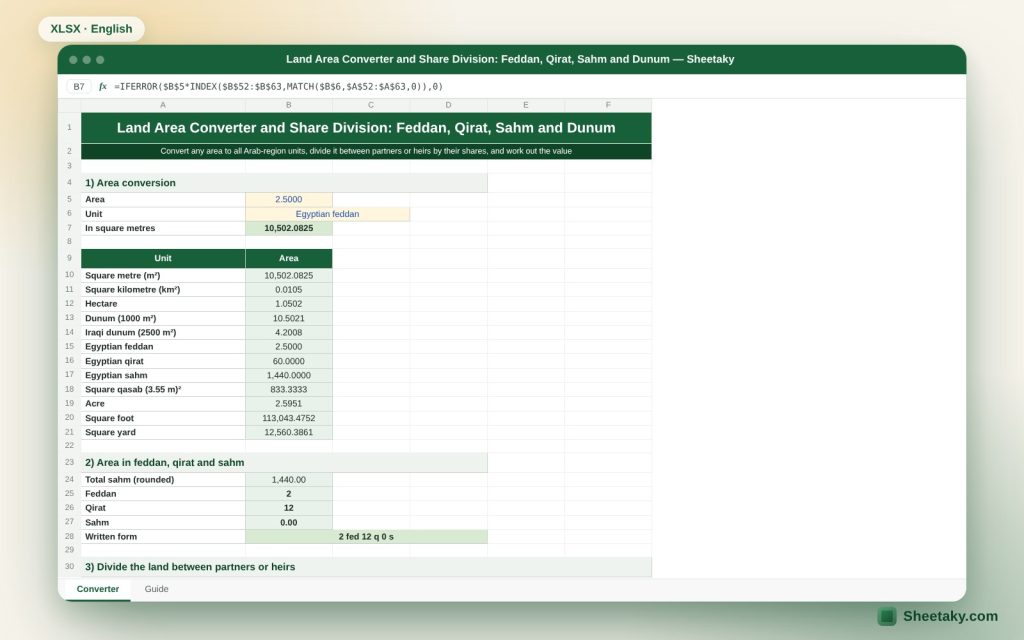
This sheet solves it by converting any area into twelve units at once, turning it into the usual feddan, qirat and sahm form found on Egyptian deeds, then dividing it between partners by shares and computing each partner’s area and the value of the share at a price per metre.
Who is it for?
- Owners and heirs who want to know each person’s part
- Real estate brokers and valuers
- Surveyors and subdivision engineers
- Lawyers and accountants dealing with deeds in different units
What is inside the sheet?
- Conversion of one area into 12 units
- Breakdown of the feddan into feddan, qirat and sahm
- A share division table between partners by numerator and denominator
- Area of each share in metres, feddan, qirat and sahm
- Value of each share at a price per square metre
- A guide sheet
How to use it
- Enter the area and choose the unit you know from the list.
- Read the area in the other units in the conversion table.
- For division enter the share denominator (such as 24) then each partner’s number of shares.
- Enter the price per square metre to see each share’s value.
- Check that the shares add up to the denominator.
Formulas used
Area in m² = area × unit factorArea in a new unit = m² ÷ new unit factorFeddan = 24 qirat , qirat = 24 sahmShare area = area × (partner shares ÷ denominator)Share value = share area × price per metre
Worked example from the sheet itself
The Egyptian feddan equals 4200.833 m², that is 0.4201 hectare.
- The qirat equals 175.035 m² and the sahm 7.293 m².
- A 2-feddan plot shared by three partners with 12, 8 and 4 shares of 24 gives them 1 feddan, 0.667 feddan and 0.333 feddan.
- At 1500 per metre the first partner’s value is about 6,301,250.
Why units differ from country to country
Traditional units grew out of local farming: the feddan was originally the area a pair of oxen could plough in a day, and the dunum likewise the area ploughable in a day. As that work varies with soil and custom, each country settled on its own figure.
The Egyptian feddan is fixed at 4200.833 m² (24 qirat × 24 sahm). The dunum is 1000 m² in common use in Jordan, Palestine, Syria and Lebanon, but 2500 m² in Iraq. The hectare is universal at 10,000 m². The qasaba is used in parts of Egypt and its square is about 3.55 m × 3.55 m = 12.6025 m². Set the unit by your country and local custom before relying on a figure.
Breaking the feddan into qirat and sahm
On Egyptian deeds the area is usually written as feddan, qirat and sahm, such as 3 feddan, 14 qirat and 9 sahm. To convert an area in metres to this form divide by 4200.833 and take the whole part as feddan, multiply the remainder by 24 and take the whole part as qirat, then multiply the remainder by 24 for the sahm.
The sheet does this automatically and rounds the sahm to the nearest whole number; if rounding reaches 24 sahm it carries to the qirat, and if that reaches 24 qirat it carries to the feddan, so you never see “24 sahm” in the output.
Dividing shares between partners and heirs
Shares are usually written as fractions: 12 of 24, or 1/8, or 3/16. The sheet takes each partner’s numerator and the total denominator, so you enter the denominator once (24, say) and each partner’s shares. If you have different denominators, unify them with a common denominator before entering.
Important: the sheet is only area arithmetic. An heir’s share is set by the religious or legal ruling in your country and not by this sheet, so refer to the court, the registrar or a lawyer to determine the shares themselves, then use the sheet to turn them into areas.
From area to value
Once the share area is known, the sheet multiplies it by the price per metre you enter. But a fair price for a small part of shared land can differ from the price of the whole because of frontage, shape and usability, so do not treat the product as an official valuation.
It is useful in negotiations when one partner buys out another: enter two different prices per metre and see the difference in the share value.
Common mistakes
- Mixing the Iraqi dunum with the Levant dunum, a factor of 2.5 apart.
- Treating the feddan as 100 qirat instead of 24.
- Taking the area from a sketch rather than the deed.
- Forgetting that the partners’ shares must add up to the denominator.
- Copying the figure into an official contract without checking with a surveyor or lawyer.
Tips for best results
- Enter the unit on the deed as it is and then convert, not the reverse.
- Keep five decimals when converting to reduce rounding errors on large plots.
- Always check the total of the shares before relying on it.
Frequently asked questions
Is the feddan the same in every Arab country?
No. This sheet uses the Egyptian feddan of 4200.833 m². Some countries use feddan to mean something else.
Does the sheet decide the heirs’ shares?
No. It only converts the shares you set into areas and values.
Can I add a unit?
Yes, in the sheet’s unit table add the name and its factor in square metres.
Why does my result not match the deed?
The deed may differ from the actual area, or rounding may differ. The deed is the reference.
Download the sheet
Press the download button at the top of the page to get the Excel file. It includes a full guide sheet, yellow input cells and formulas protected from accidental edits. The sheet is also available in Arabic from the language switcher.
The sheet is a calculation aid. Legal shares and official area are set by the competent authorities.
Related sheets
Land surveying
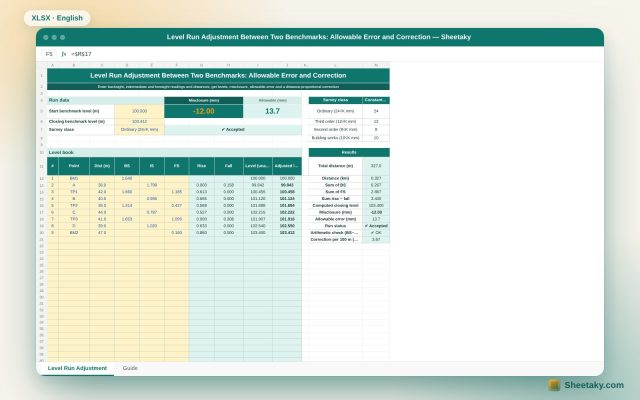
Level Run Adjustment in Excel: Misclosure, Allowable Error and Correction
An Excel sheet for a level book between two benchmarks of known level: it computes levels by the…
Land surveying
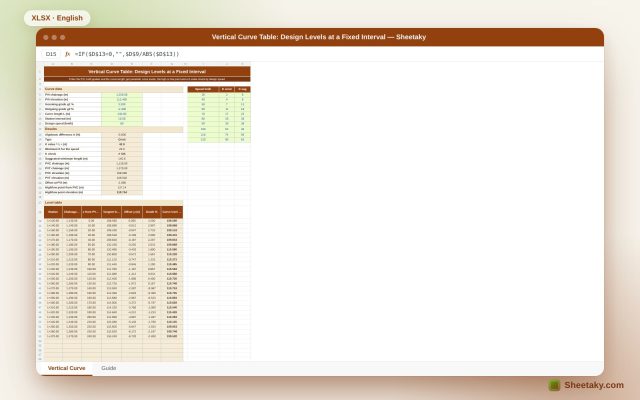
Vertical Curve Table in Excel: Design Levels, High Point and K-Value Check
An Excel sheet for designing a parabolic vertical curve between two grades: it gives a level table at…
Land surveying
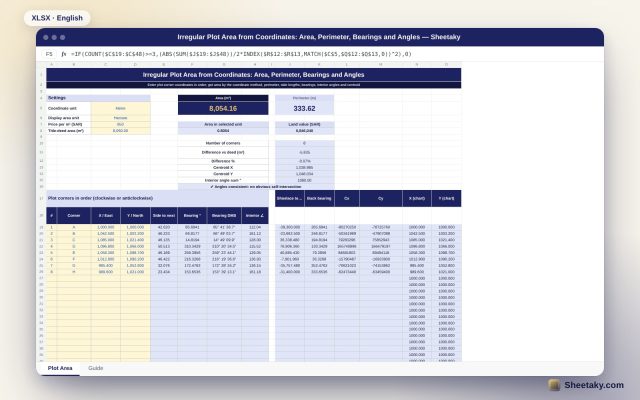
Irregular Plot Area from Coordinates in Excel: Area, Perimeter and Bearings
An Excel sheet that computes the area and perimeter of an irregular plot from its corner coordinates, with…