Irregular Plot Area from Coordinates in Excel: Area, Perimeter and Bearings
- XLSX
- 17 KB
- Version 1.0
- English
- October 23, 2026
Ready to download
Editable Excel file
This sheet is also available in: العربية
An irregular plot cannot be found by multiplying length by width, and splitting into triangles gives long calculations. The faster and more accurate way is to compute it from the corner coordinates with the coordinate (shoelace) method, the same one used by survey software.
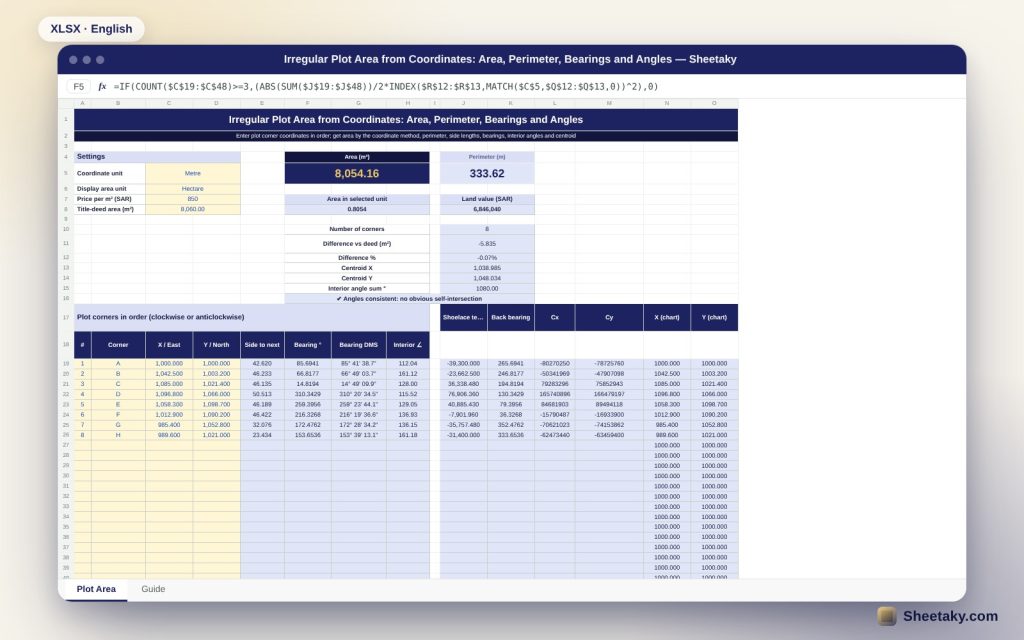
This sheet computes area and perimeter from coordinates, gives each side its length and bearing and each corner its interior angle, then draws the plot shape, compares it with the deed area and values it at your price per metre.
Who is it for?
- Surveyors and setting-out engineers
- Engineering and land subdivision offices
- Contractors and land buyers
- Real estate brokers
What is inside the sheet?
- Up to 30 corners with X and Y coordinates
- Coordinate unit: metre or foot
- Area in m², hectare, donum, feddan and ft²
- Perimeter and side length and bearing in degrees, minutes and seconds
- Interior angle at each corner, their sum and a consistency check
- Centroid, land value and the difference from the deed
- A plot shape chart and a guide
How to use it
- Pick the coordinate unit and area display unit.
- Enter the plot corners in order around it.
- Enter the price per metre and the deed area.
- Read area, perimeter and difference and review the angle check.
Formulas used
Area = ½ |Σ (Xi · Yi+1 − Xi+1 · Yi)|Side length = √(ΔX² + ΔY²)Bearing = arctan(ΔX ÷ ΔY) from north clockwiseInterior angle sum = (n − 2) × 180°Centroid X = Σ (Xi + Xi+1)(Xi·Yi+1 − Xi+1·Yi) ÷ 6A
Worked example from the sheet itself
A plot with eight corners A to H, with coordinates in metres from (1000, 1000) to (989.6, 1021.0).
- The area is 8,054.16 m², that is 0.8054 hectare, and the perimeter 333.62 m.
- At 850 per square metre the land is worth 6,846,040.
- The deed says 8,060 m², so the difference is only 5.84 m² (0.07%), and interior angles total 1080°, which is (8−2)×180, so the corners are correctly ordered.
The coordinate method
The method sums the product of each corner coordinate with the next corner, with alternating sign, then takes half the absolute value. It needs no drawing or triangles, and corner order clockwise or anticlockwise are both correct.
The angle check
If corners are ordered around the plot the interior angles sum to (n−2)×180. If two sides cross or two corners swap places that sum breaks and the sheet warns you in red.
Difference from the deed
Small differences (under 0.5%) are normal because of measuring precision. Large ones call for a re-survey or a review of the deed boundaries. The sheet does not replace a licensed surveyor.
Units
Pick the international foot if your coordinates are in feet and the sheet converts everything to metres. The Egyptian feddan is 4,200.83 m² and the donum 1,000 m².
Tips for best results
- Re-read the coordinates from the instrument before entering them.
- Start at any corner but keep the order.
- Do not repeat the first corner at the end of the list.
- For large plots use projected grid coordinates.
Frequently asked questions
How many corners fit?
30 corners.
Does it suit a plot with curved boundaries?
Split the curve into closely spaced corners.
Does it work with UTM coordinates?
Yes, they are metre coordinates and suit it well.
Is the area legally binding?
No, the binding area is issued by a licensed surveyor and the authority.
Download the sheet
Press the download button at the top of the page to get the Excel file. It includes a full guide sheet, yellow input cells and formulas protected from accidental edits. The sheet is also available in Arabic from the language switcher.
A calculation aid; the legally binding area is issued by the competent authorities.
Related sheets
Land surveying
Level Run Adjustment in Excel: Misclosure, Allowable Error and Correction
An Excel sheet for a level book between two benchmarks of known level: it computes levels by the…
Land surveying
Vertical Curve Table in Excel: Design Levels, High Point and K-Value Check
An Excel sheet for designing a parabolic vertical curve between two grades: it gives a level table at…
Land surveying
UTM and Latitude/Longitude Converter in Excel: Precise Krüger Series and Automatic Zone
An Excel sheet that converts latitude and longitude to UTM (easting and northing) and back with Krüger series…