Zakat Calculator in Excel: Cash, Gold, Silver, Trade Goods and Shares with Nisab and Hawl
- XLSX
- 12 KB
- Version 1.0
- English
- October 23, 2026
Ready to download
Editable Excel file
This sheet is also available in: العربية
Every year a Muslim faces the same question: how much zakat do I owe? The answer needs gathering scattered wealth: cash in the pocket, bank accounts, old gold with family, stock in the shop, shares, money others owe you, then deducting debts due and comparing the result with the nisab. It is easy to forget something or make a slip.
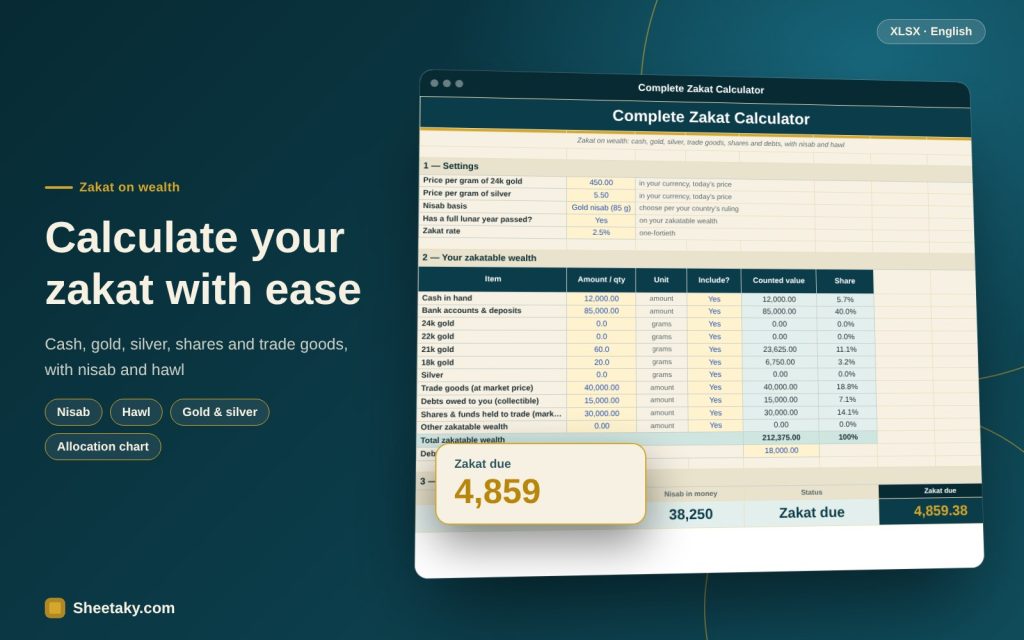
This calculator puts all of it on one board. You enter today’s gold and silver price per gram, then your wealth in clear cells, and it values each item, adds them, deducts debts due, compares the net with the nisab, checks the hawl, and shows the zakat due on a large card with a chart of your wealth mix.
Who is it for?
- Any Muslim computing zakat on wealth each year
- Shop owners and small traders with trade goods
- People holding gold, silver and shares who want one calculation
- Families computing zakat for spouses or heirs
What is inside the sheet?
- Settings: gold and silver price, nisab basis, hawl, zakat rate
- Eleven zakat items: cash, banks, gold in four karats, silver, trade goods, collectible debts, shares and others
- A Yes/No choice per item to include or exclude it
- A debts-due cell that is deducted
- Cards: net, nisab, status, zakat due
- A doughnut chart of your wealth mix and in-cell data bars
- A guide sheet
How to use it
- Enter today’s price per gram of 24k gold and of silver in your currency.
- Choose the nisab basis (gold or silver) according to your country’s ruling, and answer the hawl question.
- Enter your wealth in the yellow cells: money in currency and metals in grams.
- Choose “No” for any item you do not count, such as worn jewellery if you follow the view that it is exempt.
- Enter debts due from you and read the zakat due on the card.
Formulas used
Gold value = grams × 24k price × (karat ÷ 24)Total wealth = sum of counted valuesNet = total − debts dueNisab = 85 × gold price per gram (or 595 × silver price per gram)Zakat = net × 2.5% if the nisab is reached and the hawl has passed
Worked example from the sheet itself
An illustration with assumed prices: gold 450 per gram and silver 5.5.
- Cash 12,000, bank 85,000, 21k gold of 60 g (23,625) and 18k gold of 20 g (6,750).
- Trade goods 40,000, collectible debts 15,000 and trading shares 30,000: total 212,375.
- Debts due 18,000 give a net of 194,375 against a nisab of 38,250, so the zakat due is 4,859.38.
What the nisab is and why gold or silver
The nisab is the minimum wealth at which zakat becomes due. Jurists set it at the equivalent of 85 grams of pure gold or 595 grams of silver. Since silver is far cheaper than gold, its nisab in money is lower, so more people owe zakat. Contemporary scholars differ on which to adopt: some bodies use gold for its stability, others silver as the safer choice for the poor.
That is why we added a cell to choose the basis rather than imposing a view. Ask the fatwa authority recognised in your country; some countries publish the nisab in local currency every year.
The hawl: when the year starts
The hawl is a full lunar year passing over wealth that is at or above the nisab. If you held wealth above the nisab on 1 Muharram, your zakat falls due the next 1 Muharram. If wealth dropped below the nisab during the year and then returned, the basic view is that a new year starts, though details differ, and trade profits are added to their capital in its hawl.
Choose “Yes” in the calculator if the hawl has passed, otherwise the status shows “Hawl not complete”. It helps to fix one day a year for paying zakat, such as the first of Ramadan, and compute everything then.
What is included and what is disputed
Agreed by the majority of scholars: cash and deposits, trade goods at market value, saved gold and silver, and collectible debts.
Disputed among scholars: gold and silver jewellery for personal use (some schools require zakat, others do not), shares (for trading, zakat on full market value; for long-term investment, consider the company’s zakatable assets or the profits), and rented property (the majority say zakat is on the accumulated rent, not the property). That is why every item has a Yes/No choice, so you apply the ruling you are comfortable with.
Debts: what is deducted and what is not
Debts due from you within the year are deducted from zakatable wealth by many scholars. Long-term debts such as a car or property loan over years are disputed: some deduct only the current year’s instalments, others the whole debt. We provided a cell for “this year’s instalments” because it is the more cautious view.
Debts others owe you are added if collectible, and left out while hopeless until collected.
How to pay and to whom
Zakat is paid in cash or kind to the recipients named in the Quran in eight categories: the poor, the needy, those who collect it, those whose hearts are to be reconciled, freeing captives, debtors, in the cause of God and the wayfarer. Many countries have recognised bodies that collect and distribute it, which is the surest way to reach those entitled.
If you distribute to needy relatives, note that zakat is not paid to one’s parents and children according to the majority view, while it may be given to other needy relatives as charity and kinship.
Updating the calculator each year
- Copy the file and name it with the Hijri year.
- Update the gold and silver price on the day you compute zakat.
- Change balances from bank statements and the stock count.
- Review debts due from you and to you.
- Record the zakat figure and the payment date in a separate file.
Tips for best results
- Compute on a fixed day each year so it is easy to remember.
- Use the price at which you could sell the gold, not the jeweller’s retail price.
- Keep last year’s copy for comparison.
Frequently asked questions
Is the calculator a fatwa?
No, it is a calculation tool. Rulings come from scholars in your country, and the calculator lets you apply the view of the ruling you follow.
Does it cover zakat on crops and livestock?
No, it is for zakat on wealth.
Which currency does it use?
Any currency. Enter prices and amounts in the same currency.
What about zakat al-fitr?
Zakat al-fitr is a measure of staple food or its value per person, worked out by the number of family members, and has its own calculation not included here.
Download the sheet
Press the download button at the top of the page to get the Excel file. It includes a full guide sheet, yellow input cells and formulas protected from accidental edits. The sheet is also available in Arabic from the language switcher.
The calculator is an aid and not a religious ruling.
Related sheets
Smart dashboards
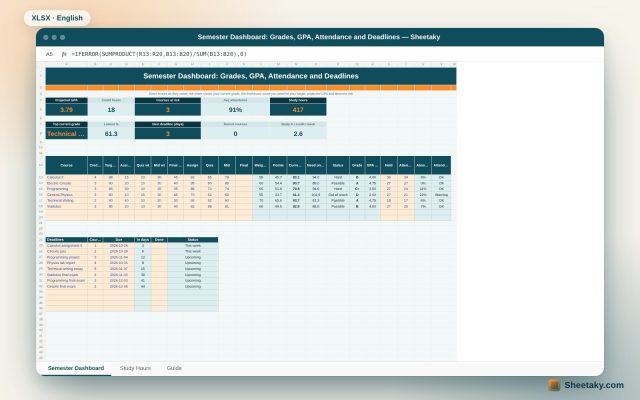
Student Semester Dashboard in Excel: Grades, GPA, Attendance and the Score Needed on the Final
An Excel board for university students: enter assignment, quiz and midterm scores to see your current grade in…
Smart dashboards
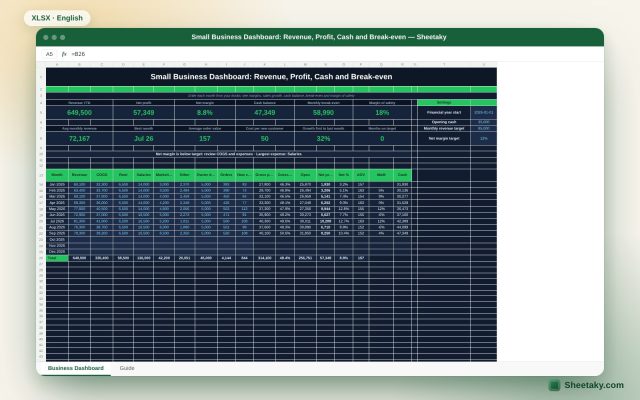
Small Business Dashboard in Excel: Revenue, Profit, Cash and Break-even
A monthly Excel board for a small business: enter revenue, costs and owner draws to calculate profit, margins,…
Smart dashboards
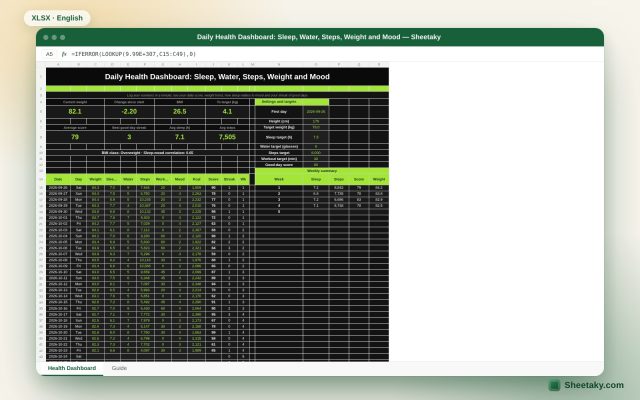
Daily Health Dashboard in Excel: Sleep, Water, Steps, Weight and Mood in One Score
An Excel board to track your daily health: log weight, sleep, water, steps, workout and mood to get…