Student Semester Dashboard in Excel: Grades, GPA, Attendance and the Score Needed on the Final
- XLSX
- 20 KB
- Version 1.0
- English
- October 23, 2026
Ready to download
Editable Excel file
This sheet is also available in: العربية
Mid-semester a student asks: how much do I need on the final to get an A? and answers with a guess or a clumsy calculation across different weights. Many discover they are barred from a course too late because nobody calculated their absence rate.
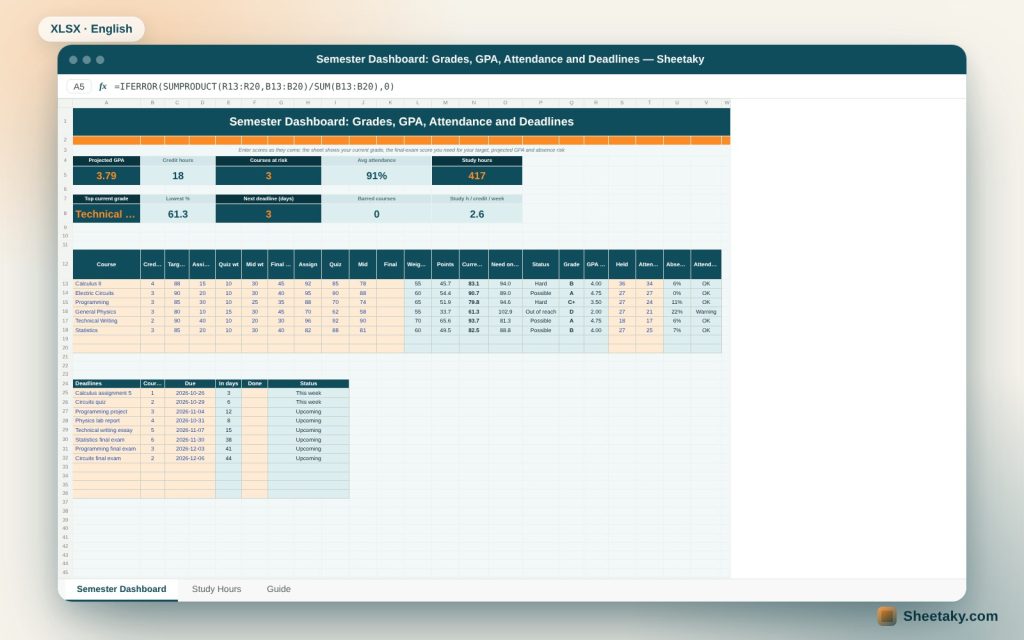
This board gathers every course of the semester in one table: credits, target, assessment weights and current scores. It calculates the current grade over the weight completed, the score needed on the final, the course letter, points and projected GPA, monitors attendance against the allowed limit and collects deadlines and exams in a list.
Who is it for?
- University and technical college students
- High school students tracking grades
- Academic advisers
- Parents following their children
What is inside the sheet?
- A table of eight courses with assignment, quiz, midterm and final weights
- A current grade over the weight completed
- The score needed on the final and a target status: comfortable, possible, hard or out of reach
- Course letter, GPA points and an editable grade scale
- Attendance and absence with warning and barred flags
- Weekly study hours per course
- A deadline list with this-week and overdue status
How to use it
- Enter courses with credits, target and assessment weights.
- Enter each score as it comes and leave the final blank.
- Record lectures held, attendance and study hours.
- Review the hard courses and the next deadline.
Formulas used
Points earned = Σ(score × weight) ÷ 100Current grade = points earned ÷ weight completedNeeded on final = (target − points earned) ÷ final weightGPA = Σ(course points × credits) ÷ Σ creditsAbsence = 1 − attended ÷ held
Worked example from the sheet itself
Projected GPA is 3.79 out of 5 over 18 credit hours.
- Physics has a current grade of 61.3% and needs 102.9% on the final to reach an 80 target, so it is out of reach and needs a fallback plan.
- Calculus and Programming each need about 94% on the final.
- Physics absence is 22%, in the warning zone close to the 25% limit.
- Average attendance is 91% and study hours are 417, which is 2.6 hours per credit per week.
The score needed on the final
The equation is simple: the target minus what you have earned, divided by the final weight. When the result exceeds 100 the target is out of reach however well you do, so the better decision is to lower the target to a feasible letter instead of getting discouraged.
Current grade, not cumulative
Someone with 90 on assignments and the quiz is not at 90 overall, because the heavily weighted final remains. The board divides points by the completed weight only, so you know your performance on what has been graded without being misled by what has not.
Barred status
Universities set a maximum absence, often 25%. The board warns you when absence nears 80% of the limit and shows which course needs commitment. The limit is editable to match your university rules.
Study hours
A common rule is two to three hours of study per week for each credit hour. The board compares your actual time with the credits and the current week to show whether you are falling short.
Tips for best results
- Update scores as soon as they are released.
- Start with the course that has the highest weight and weakest grade.
- Block fixed study times in your timetable.
- Review the board weekly, not at the end of the semester.
Frequently asked questions
Can I change the grade scale?
Yes, the table is editable for a 4 or 5 scale or any system.
What if there is no midterm?
Set its weight to zero and spread the rest.
Does it compute cumulative GPA?
The GPA here is for the current semester only.
Download the sheet
Press the download button at the top of the page to get the Excel file. It includes a full guide sheet, yellow input cells and formulas protected from accidental edits. The sheet is also available in Arabic from the language switcher.
Weights, absence limits and grade scales differ between universities; check your university rules.
Related sheets
Smart dashboards
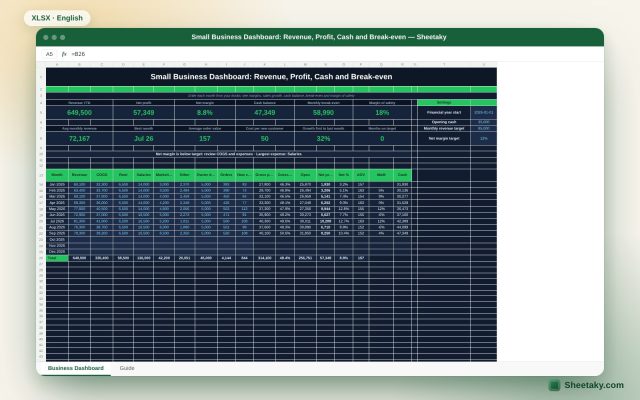
Small Business Dashboard in Excel: Revenue, Profit, Cash and Break-even
A monthly Excel board for a small business: enter revenue, costs and owner draws to calculate profit, margins,…
Smart dashboards
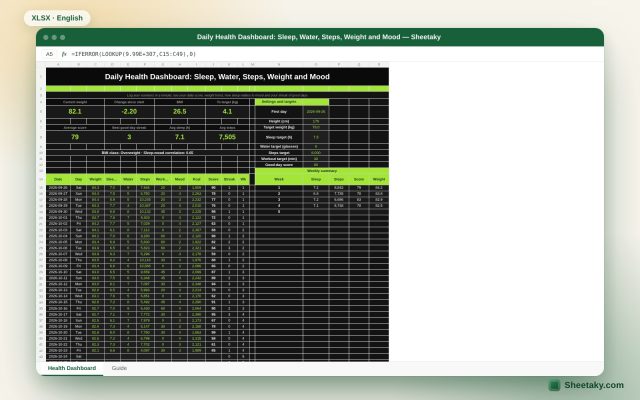
Daily Health Dashboard in Excel: Sleep, Water, Steps, Weight and Mood in One Score
An Excel board to track your daily health: log weight, sleep, water, steps, workout and mood to get…
Smart dashboards
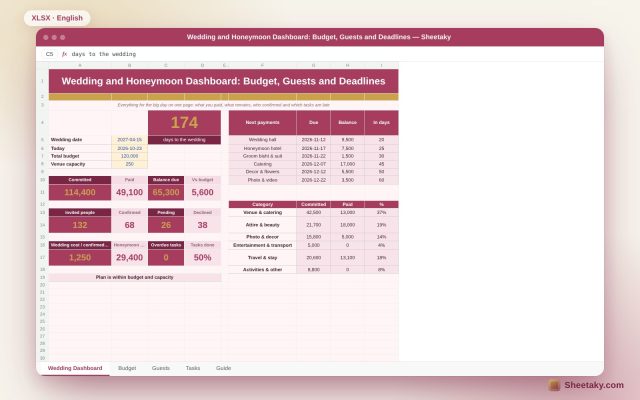
Wedding and Honeymoon Plan Dashboard in Excel: Budget, Guests, Payments and Deadlines
An Excel board to plan a wedding and honeymoon: a budget with estimates, contract prices and payments, a…