Exam Study Planner in Excel: Daily Hours and Subject Priorities
- XLSX
- 12 KB
- Version 1.0
- English
- October 23, 2026
Ready to download
Editable Excel file
This sheet is also available in: العربية
Before exams many students fall into random studying: they study what they like and postpone what they fear. Days before the exam they find a whole subject was never opened. Organising study is not a luxury; it means knowing how many hours each subject needs, how many days remain and where the danger is.
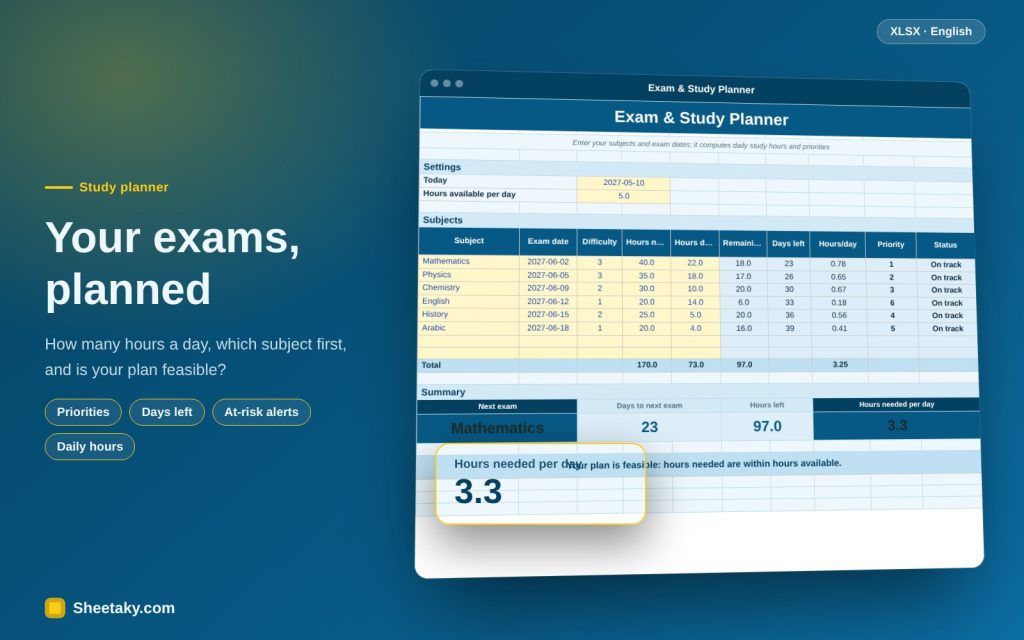
This sheet does that for you. You enter your subjects, each exam date, difficulty (1 to 3), the study hours needed and what you have done, and your available hours per day, and it computes what remains, the days left and the daily hours needed per subject, ranks priority, shows each subject’s status and tells you whether your plan is feasible.
Who is it for?
- School and university students before tests
- People preparing for professional exams or certificates
- Parents helping children organise
- Anyone studying several subjects at once
What is inside the sheet?
- Settings: today’s date and available hours per day
- A table of 8 subjects: exam date, difficulty, hours needed and done
- Remaining hours, days left and daily hours needed
- Priority ranking and colour status
- Cards: next exam, days, hours left, hours needed per day
- A feasibility message
- A done/remaining chart and a guide sheet
How to use it
- Enter today’s date and the study hours you have each day.
- Enter each subject with its exam date, difficulty and hours needed.
- Update hours done weekly.
- Start with priority 1.
- If a subject shows “At risk” add time or rearrange your day.
Formulas used
Remaining = hours needed − hours doneDays left = exam date − todayHours per day = remaining ÷ days leftPriority = rank of (hours per day × difficulty)
Worked example from the sheet itself
Today is 10 May 2027 with 5 hours available a day and six subjects.
- Mathematics: 18 hours remaining and 23 days, about 0.78 hours a day, and priority 1.
- Physics is priority 2 and chemistry priority 3.
- Total remaining is 97 hours and 3.25 hours a day are needed, below 5, so the plan is feasible.
Why priority = hours per day × difficulty
Two subjects with the same remaining hours can differ in urgency: one is in two weeks, the other in a month. So we divide remaining hours by days left to get the daily pressure. We then multiply by difficulty because a hard subject needs more attention and repetition than the numbers alone show.
It is a simple rule that gives a reasonable order, but you know yourself best: raise the difficulty of a subject you feel weak in.
Estimating hours needed
Ask yourself: how many hours to finish the syllabus once, then once more for revision, then to solve past papers? A subject with a big syllabus and many papers may need 40 hours and a small one 15. Do not be over-optimistic; optimistic estimates are the main reason plans fail.
After a week of real study compare what you did with your estimate and correct the numbers.
What “At risk” means
When a subject’s daily hours needed exceed the hours you have each day its status becomes “At risk”. The fix: give it more days, lower what you demand of lighter subjects, or ask a teacher or classmate for help. If the exam date passes and hours remain it shows “Overdue”.
Tips for better study
- Study hard material at your peak energy and easy material when tired.
- Use 45-minute sessions with 10-minute breaks.
- Review a lesson after a day, then after a week.
- Sleep enough; sleep consolidates what you learned.
- Do not leave revision to the night before.
Balance and wellbeing
Set available hours realistically, within your energy, because overdoing it leads to burnout. If you feel intense anxiety about exams, talk to someone you trust or your school counsellor.
Tips for best results
- Update hours done every week.
- Keep empty days as a revision reserve.
- Print the table and stick it above your desk.
Frequently asked questions
How many subjects?
Eight subjects.
What does difficulty mean?
A number from 1 (easy) to 3 (hard) that raises a subject’s priority.
Can I change today’s date?
Yes, enter any date to see the plan as time passes.
Does it guarantee success?
No, it is an organising tool; success comes from your study.
Download the sheet
Press the download button at the top of the page to get the Excel file. It includes a full guide sheet, yellow input cells and formulas protected from accidental edits. The sheet is also available in Arabic from the language switcher.
A study organiser and not a guarantee of results.
Related sheets
Smart dashboards
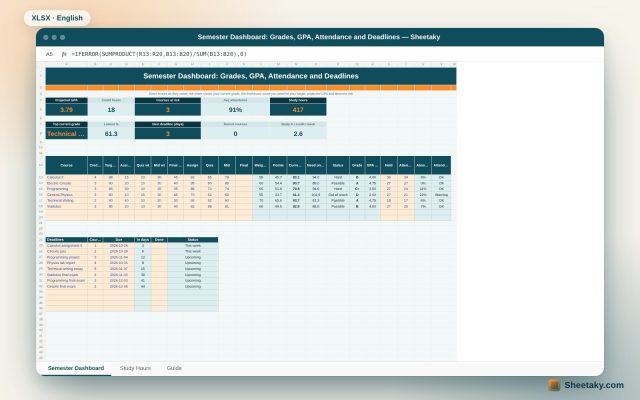
Student Semester Dashboard in Excel: Grades, GPA, Attendance and the Score Needed on the Final
An Excel board for university students: enter assignment, quiz and midterm scores to see your current grade in…
Smart dashboards
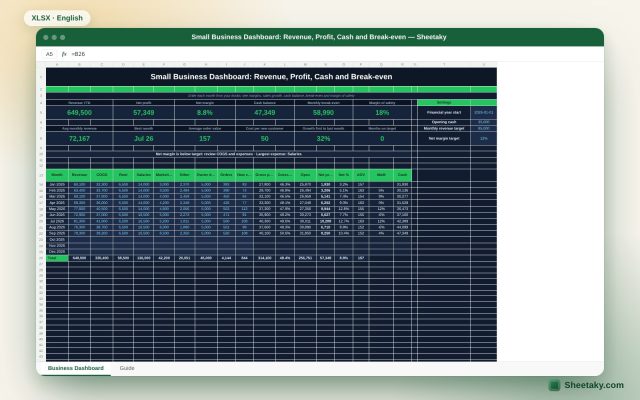
Small Business Dashboard in Excel: Revenue, Profit, Cash and Break-even
A monthly Excel board for a small business: enter revenue, costs and owner draws to calculate profit, margins,…
Smart dashboards
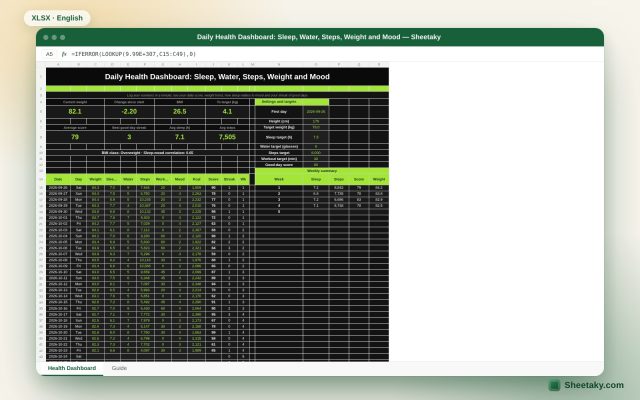
Daily Health Dashboard in Excel: Sleep, Water, Steps, Weight and Mood in One Score
An Excel board to track your daily health: log weight, sleep, water, steps, workout and mood to get…