Quran Khatma Plan in Excel: Daily and Per-Prayer Wird with a 30-Juz Tracker
- XLSX
- 18 KB
- Version 1.0
- English
- October 23, 2026
Ready to download
Editable Excel file
This sheet is also available in: العربية
Many people start a khatma with enthusiasm and stumble in the second week. The cause is usually the lack of a clear plan: how many pages today? where am I? am I behind? And anyone preparing for Ramadan wants to know in advance how much to read daily to finish once or twice.
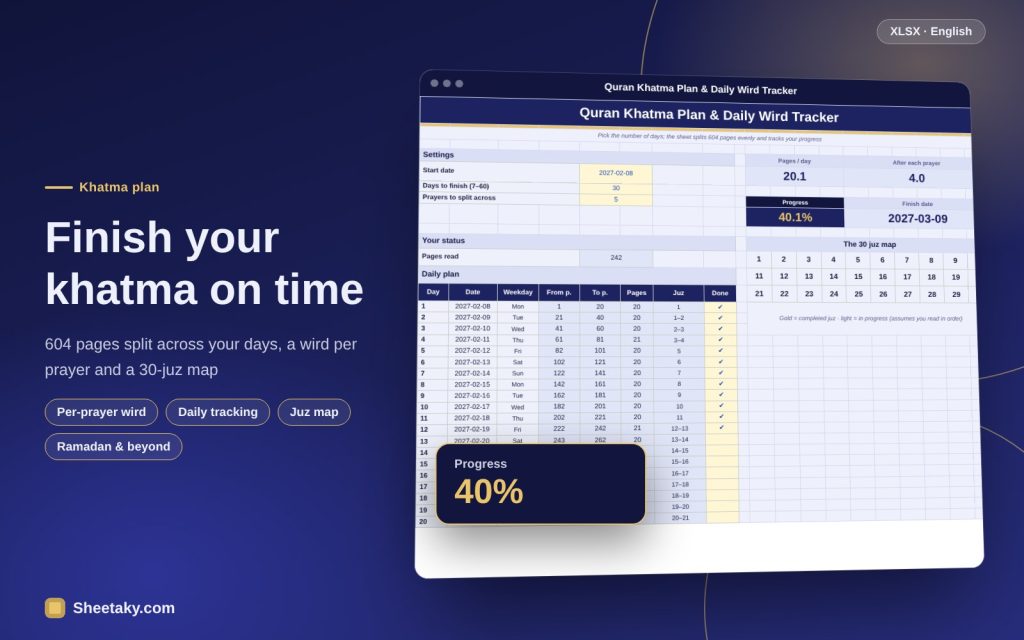
This sheet answers those questions. You enter the start date and the number of days (7 to 60) and it divides the Mushaf over the days, giving the pages to read each day with the matching juz, a wird after each prayer, and a ✔ to tick when done, so your progress, the 30-juz map and the finish date update.
Who is it for?
- Anyone wanting to complete the Quran in Ramadan or any time
- Families doing a group khatma
- Students of study circles tracking their revision
- Anyone turning reading into a daily habit
What is inside the sheet?
- Settings: start date, number of days and prayers to split across
- Cards: pages per day, wird per prayer, progress and finish date
- A table of up to 60 days with date, weekday, pages and juz
- Colouring: green for done, red for missed, yellow for today
- A map of the 30 juz that colours with your progress
- A bar chart of pages per day
- A guide sheet
How to use it
- Enter the khatma start date and the number of days you want (30 for a monthly khatma).
- Read the pages for today and the wird per prayer, and fix it in your schedule.
- After reading, tick ✔ in the “Done” cell of the day.
- Follow your progress and the juz map, and check days shaded red.
- If you fall behind, add pages to later days or change the number of days.
Formulas used
Pages per day = 604 ÷ number of daysFrom page = ROUND(604 × (day − 1) ÷ days) + 1To page = ROUND(604 × day ÷ days)Juz = 1 + INT((page − 2) ÷ 20)Progress = pages of completed days ÷ 604
Worked example from the sheet itself
A 30-day khatma starting 2027-02-08 is about 20.1 pages a day.
- The wird after each of the five prayers is about 4 pages.
- Day 1 is pages 1 to 20, day 2 is 21 to 40, and so on to 585–604 on day 30.
- After 12 completed days the pages read are 242, the progress 40.1% and the finish date 2027-03-09.
Why a plan with numbers beats good intention
A sincere intention starts the khatma, but a specific plan finishes it. When you know you owe 20 pages a day, and that this means four pages after each prayer, the big goal (604 pages) becomes a small task tied to known times in your day. And when you see a completed day turn green and the next one waiting, an inner drive to continue builds.
This is called habit stacking: reading after Fajr, reading after Asr, and so on, so you never need to decide each day when to read.
How the sheet distributes pages and juz
The reference Mushaf is the Madinah Mushaf of 604 pages, whose juz start at pages 1, 22, 42, 62 and so on, 20 pages apart, with juz 30 ending at page 604. The sheet divides pages over days by rounding, so some days you read 20 pages and some 21 so the total is exactly 604.
If your copy is numbered differently, the percentage-based calculation remains useful, but page numbers may differ, so check them.
A Ramadan khatma: one or more?
For one khatma in Ramadan choose 30 days (or 29 if the month has 29). For two choose 15 days, giving about 40 pages a day, that is 8 pages after each of the five prayers. What you choose should be sustainable: the Prophetic guidance is moderation, “the most beloved deeds to God are the most consistent, even if small”.
Try changing the number of days in the sheet to see how many pages you need each day and decide by your time. You can set the number of prayers to 3 or 4 if you do not read after all of them.
Handling missed days
You will miss days. The worst reaction is to drop the whole plan. Read the late pages in two sittings the next day, or spread them over the remaining days by changing the number of days. Missed days show red to remind you without scolding you.
Tips to keep going: read at a fixed time, keep the Mushaf or app within reach, and share the plan with a family member so you remind each other.
Reflection, not speed
The sheet helps with quantity, but the aim of the Quran is reflection and action. If you feel you are rushing, add days. Some people combine the khatma plan with a weekly reflection on one surah. You can use the “Juz” column to know which juz you are in when consulting a tafsir.
Tips for best results
- Print the table and stick it on the fridge or in the living room.
- Start two weeks before Ramadan as a trial to set the number of days.
- Keep a copy of the file for each khatma to compare year to year.
Frequently asked questions
Does the juz match the Madinah Mushaf?
Yes, the calculation is based on 604 pages and about twenty pages per juz.
What are the minimum and maximum days?
From 7 to 60 days.
Does the sheet know today’s date?
Yes, it colours today yellow and missed unticked days red.
Can I complete several khatmas?
Copy the file for each khatma.
Download the sheet
Press the download button at the top of the page to get the Excel file. It includes a full guide sheet, yellow input cells and formulas protected from accidental edits. The sheet is also available in Arabic from the language switcher.
The sheet is a reading organiser and not a substitute for learning from scholars.
Related sheets
Smart dashboards
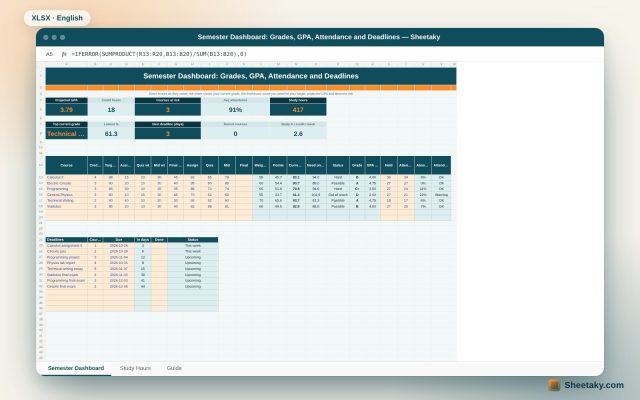
Student Semester Dashboard in Excel: Grades, GPA, Attendance and the Score Needed on the Final
An Excel board for university students: enter assignment, quiz and midterm scores to see your current grade in…
Smart dashboards
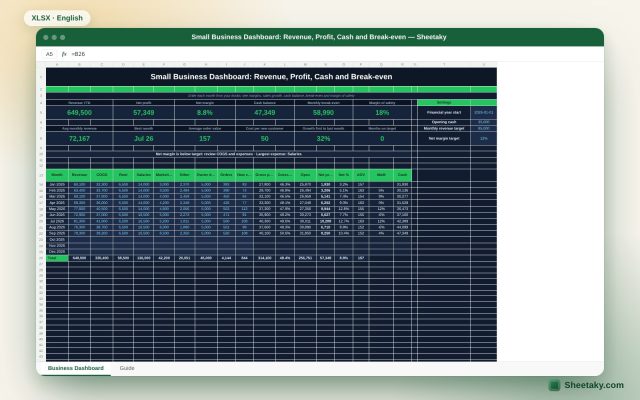
Small Business Dashboard in Excel: Revenue, Profit, Cash and Break-even
A monthly Excel board for a small business: enter revenue, costs and owner draws to calculate profit, margins,…
Smart dashboards
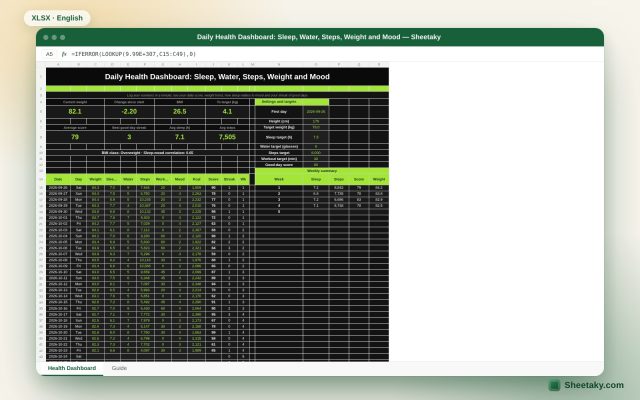
Daily Health Dashboard in Excel: Sleep, Water, Steps, Weight and Mood in One Score
An Excel board to track your daily health: log weight, sleep, water, steps, workout and mood to get…