Body and Calorie Plan in Excel: BMI, BMR, Target Calories, Protein and Water with a Weight Log
- XLSX
- 12 KB
- Version 1.0
- English
- October 23, 2026
Ready to download
Editable Excel file
This sheet is also available in: العربية
Most people talk about “losing weight” without knowing a single number: how many calories does my body actually need? how many should I cut? how many weeks will it take? Without numbers the attempt becomes a random diet that is hard to sustain. On the other side, someone who wants to gain or maintain weight does not know how much to eat.
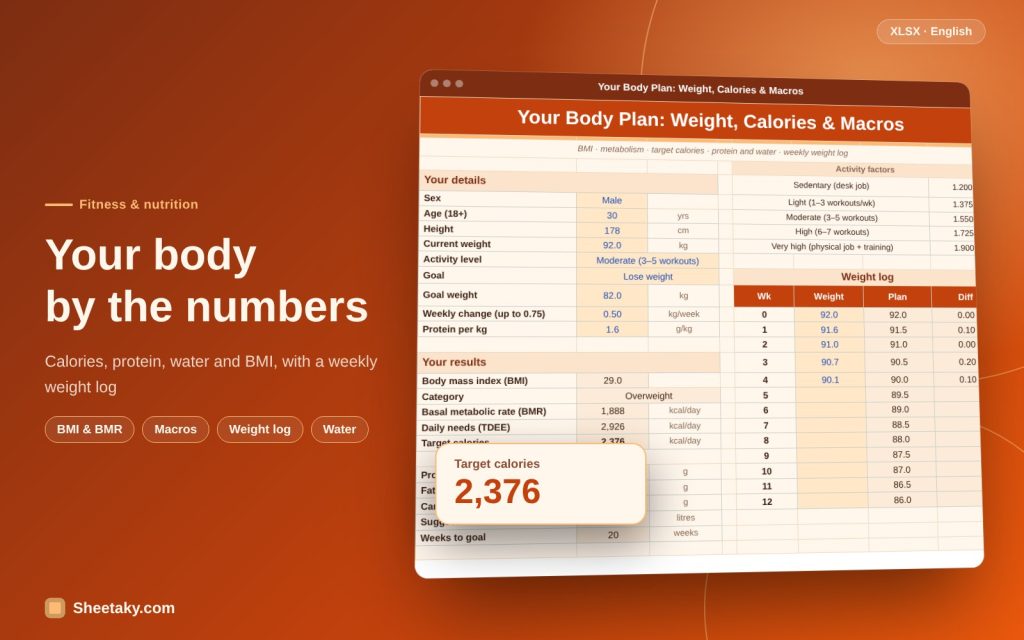
This sheet gives you those numbers from your details: sex, age, height, weight and activity. It computes BMI, basal metabolic rate (BMR) and daily needs (TDEE), then target calories for your goal (lose, maintain or gain) at a safe weekly rate, splits them into protein, fat and carbohydrate, suggests a water amount, estimates the weeks left, and tracks your weekly weight against the plan line.
Who is it for?
- Healthy adults who want to manage weight with numbers
- People training who want to know their calories and protein
- Coaches preparing starting plans for clients
- Anyone wanting to know if their weight is in the normal range
What is inside the sheet?
- Your details: sex, age, height, weight, activity, goal, goal weight and rate of change
- BMI and its category
- Basal metabolism and daily needs
- Target calories with a safe minimum and a warning
- Protein, fat and carbs in grams and water in litres
- Weeks remaining to goal
- A 12-week log with a chart of your weight against the plan
- A guide sheet
How to use it
- Enter your sex, age (18 or over), height and current weight.
- Choose your activity level honestly; most people overestimate it.
- Choose the goal, goal weight and weekly rate of change (no more than 0.75 kg).
- Read the target calories, macros and water.
- Log your weight each week in the morning under the same conditions and compare with the plan.
Formulas used
BMI = weight ÷ (height in metres)²BMR for men = 10 × weight + 6.25 × height − 5 × age + 5 (women −161)TDEE = BMR × activity factorTarget calories = TDEE ∓ (weekly rate × 7700 ÷ 7)Protein = g/kg × weight, fat = 25% of calories ÷ 9, carbs = the rest ÷ 4Water = weight × 0.035 litres
Worked example from the sheet itself
A 30-year-old man, 178 cm, 92 kg, moderately active, aiming for 82 kg at 0.5 kg a week.
- BMI = 29.0 (overweight), BMR = 1,888 kcal and daily needs 2,926.
- Target calories are 2,376, with protein 147 g, fat 66 g, carbs 298 g and water 3.2 litres.
- The weeks remaining to goal are 20.
What BMR is and the Mifflin–St Jeor equation
Basal metabolic rate (BMR) is the calories your body burns completely at rest to run the heart, lungs and brain. The Mifflin–St Jeor equation estimates it and is considered among the most accurate available for healthy people, using weight, height, age and sex. It is an estimate and not a lab measurement, so your real figure may differ by about 10 percent.
BMR is then multiplied by an activity factor to give total daily energy expenditure (TDEE): 1.2 for a desk worker who does not train up to 1.9 for someone combining heavy physical work with training. The commonest mistake is overestimating activity and so computing a need higher than reality.
How the calorie deficit is built
One kilogram of body weight is estimated at about 7700 kcal. So losing 0.5 kg a week needs a daily deficit of about 550 kcal. This is approximate, and as your weight falls your needs fall and progress slows, which is normal.
The safe rule: the rate of loss should not exceed about 0.5–1% of body weight a week, which is why we capped it at 0.75 kg. Any goal that would take you below a minimum (1,500 for men and 1,200 for women, or BMR if higher) is raised automatically by the sheet with a warning, and you should not go below it without medical supervision.
Macros: protein, fat and carbohydrate
Protein supports muscle and fullness, and recommendations for active people range from 1.2 to 2.2 g per kg, with a default of 1.6. Fat is necessary for hormones and absorbing vitamins, and we set 25% of calories. Carbohydrate is the rest of the calories and fuels training.
This is a starting point and not a rigid prescription. If you have kidney disease, diabetes or another condition things may differ, so consult your doctor.
BMI: useful but limited
BMI is a simple number comparing weight with height, classing it as underweight (below 18.5), normal (up to 24.9), overweight (up to 29.9) and obese (30 or more). Its limit is that it does not distinguish muscle from fat, so a muscular athlete may be classed “overweight”. Use it as a first indicator and not a verdict, and add waist and body fat measures if you can.
If BMI is below 18.5 the sheet will not cut your calories even if you chose a weight-loss goal, because loss is not appropriate in that case.
The weight log: how to read it
Body weight fluctuates daily with water, food, salt and the menstrual cycle. So record weekly at a fixed time (morning after waking), and look at the trend over 3–4 weeks rather than one number. The sheet shows the difference from the plan line: green is better than plan and red is slower.
If progress stalls for several weeks, review your activity and actual calories, and recalculate with your new weight.
Who this sheet does not suit
- Anyone under 18.
- Pregnant or breastfeeding women.
- People with eating disorders or a history of them: avoid counting calories and consult a specialist.
- People with chronic illness or medication affecting weight and metabolism.
- Anyone needing a therapeutic plan: clinical nutrition is set by a doctor or dietitian.
Tips for best results
- Weigh yourself under the same conditions: morning, after the toilet and before eating.
- Make the plan small and steady rather than harsh and temporary.
- Review the numbers every 4 weeks.
Frequently asked questions
Are the numbers accurate?
They are estimates from well-known equations and may differ from your real need. Adjust them by your results over several weeks.
Why will my calories not go below a certain level?
There is a safe minimum (1,500 for men and 1,200 for women, or BMR if higher).
Does it suit weight gain?
Yes, choose gain and it adds a surplus at the weekly rate you set.
Is it a substitute for a doctor?
No, it is a guide for healthy people.
Download the sheet
Press the download button at the top of the page to get the Excel file. It includes a full guide sheet, yellow input cells and formulas protected from accidental edits. The sheet is also available in Arabic from the language switcher.
A guide for healthy adults and not medical advice.
Related sheets
Smart dashboards
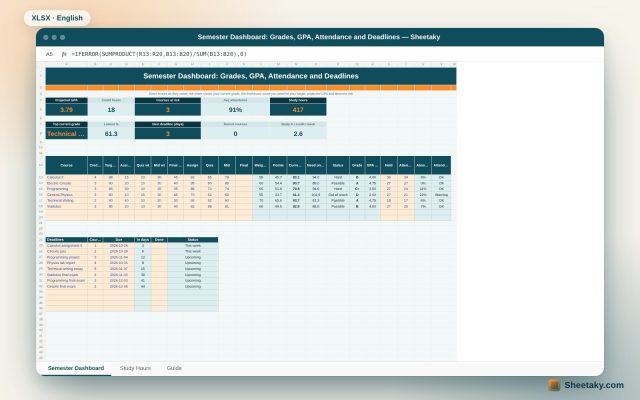
Student Semester Dashboard in Excel: Grades, GPA, Attendance and the Score Needed on the Final
An Excel board for university students: enter assignment, quiz and midterm scores to see your current grade in…
Smart dashboards
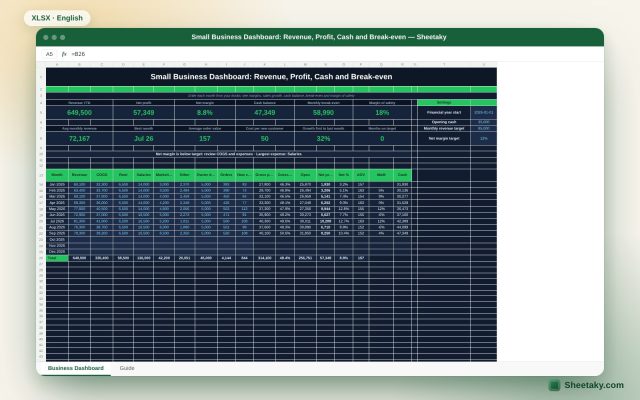
Small Business Dashboard in Excel: Revenue, Profit, Cash and Break-even
A monthly Excel board for a small business: enter revenue, costs and owner draws to calculate profit, margins,…
Smart dashboards
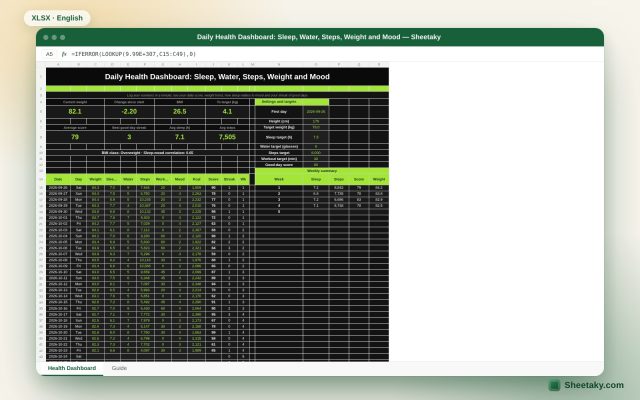
Daily Health Dashboard in Excel: Sleep, Water, Steps, Weight and Mood in One Score
An Excel board to track your daily health: log weight, sleep, water, steps, workout and mood to get…