Structural Steel Weight Take-Off in Excel: IPE, HEA, HEB, UPN, Angles and Plates in Tonnes and Cost
- XLSX
- 16 KB
- Version 1.0
- English
- October 23, 2026
Ready to download
Editable Excel file
This sheet is also available in: العربية
The quantity engineer on steel structures spends hours collecting section lengths and multiplying them by per-metre weights from tables, then adding plates, connections and waste. Forgetting one section or reading a wrong weight is enough to change a tender price by thousands.
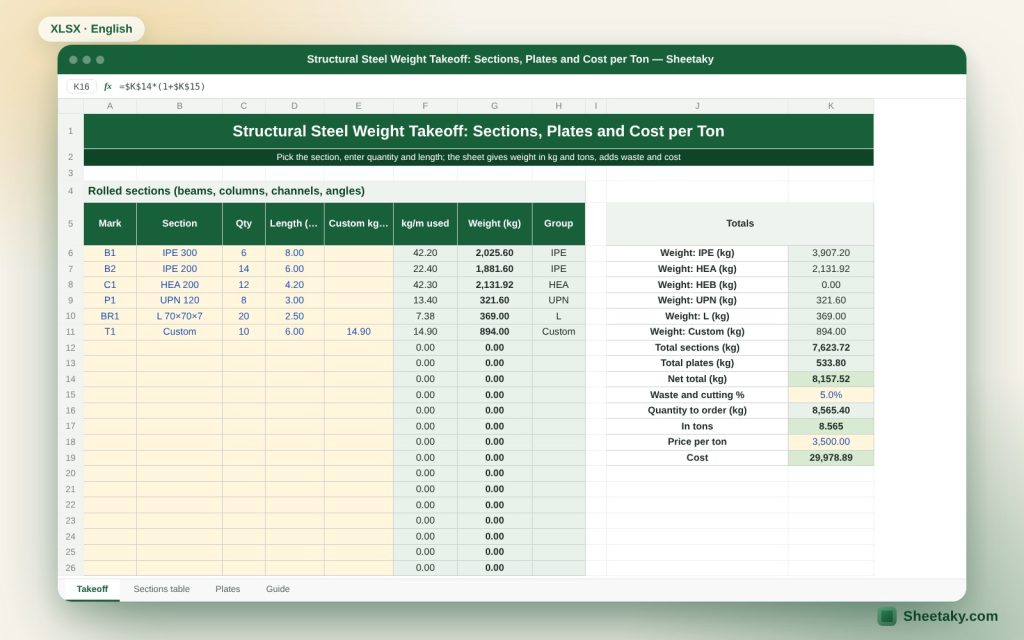
This sheet automates the take-off. You pick the section from a list (IPE, HEA, HEB, UPN, angles) and it fetches the per-metre weight from the included table; you enter the length and count and it computes the weight. For hollow sections and pipes a calculator works the weight out from dimensions and thickness, and a plate calculator uses dimensions and thickness at a density of 7850 kg/m³. Then it adds waste and computes the total weight in tonnes and the cost.
Who is it for?
- Quantity and estimating engineers in steel companies
- Structural engineers and designers
- Contractors and steel fabricators
- Students
What is inside the sheet?
- A take-off sheet: items with section, length, count and weight
- A table of standard section weights per metre
- A calculator for pipes and square and rectangular hollow sections
- A plates sheet: dimensions, thickness, count and weight
- Waste percentage and total weight in tonnes
- Price per tonne and cost
- A guide sheet
How to use it
- On the take-off sheet choose the section from the list and enter the length in metres and the count.
- For pipes and hollow sections use the calculator and carry the per-metre weight into the item.
- For plates use the plates sheet with dimensions in millimetres.
- Enter the waste percentage and the price per tonne.
- Read the total weight in tonnes and the cost.
Formulas used
Item weight = weight per metre × length × countPlate weight = length × width × thickness × 7850 (metres)Plate weight with thickness in mm = thickness (mm) × 7.85 kg/m²Pipe weight per metre = π × (outer diameter − thickness) × thickness × 7850Total weight = sum × (1 + waste)
Worked example from the sheet itself
IPE 200 weighs about 22.4 kg/m, so a 6 m beam = 134.4 kg.
- A 10 mm plate weighs 78.5 kg per m², so a 0.3 × 0.3 m plate weighs 7.07 kg.
- With 5% waste every 10 tonnes of take-off becomes 10.5 tonnes to buy.
Steel density and the basis of the calculation
The density of structural steel is about 7850 kg/m³, so a plate 1 mm thick and 1 m² in area weighs 7.85 kg. Plates are therefore easy: thickness in millimetres times 7.85 gives kg per square metre. Sections get their per-metre weights from the mill tables and European standards such as IPE and HEA, because their profiles have fillet radii that are hard to compute from dimensions alone.
The weights in the sheet are standard values, but different mills can differ slightly in tolerance. For real purchasing ask the supplier for the actual weight.
What the take-off includes and excludes
The sheet takes off the basic weights of sections and plates. It does not automatically compute connection weights (end plates, cleats, bolts, welds) or protective and fireproofing coatings. These are usually estimated as a percentage of the structure weight (5 to 15 percent depending on connection complexity) or taken off as separate items. Add them as items in the sheet or raise the waste percentage to cover them once agreed.
Choosing the waste
Steel waste comes from cutting and offcuts and falls with better planning of standard lengths (6 and 12 m). Some take-offs raise it to about 5 percent, and more for small sections. For plates cut to shapes it reaches 10 percent or more. Set the figure from previous projects or the actual cutting pattern.
Pricing per tonne
Structural steel is usually priced per tonne for the material, with fabrication (cutting, welding, assembly) added, then painting, then transport and erection. The sheet gives material cost only at the price per tonne you enter. For full pricing use the “Tender Price Build-Up” sheet on the site to build a unit rate from direct cost, overheads and profit.
Common take-off mistakes
- Mixing net length with actual cut length after waste.
- Forgetting base plates and stiffeners.
- Using the weight of a section from a different standard (IPE instead of IPN).
- Entering thickness in centimetres instead of millimetres.
- Treating theoretical weight as the final purchase weight.
A quick review of the take-off
Compare the total weight with the weight per square metre of floor of a similar building you hold data for. If the figure is an outlier, review the take-off. Comparing with a similar previous project of your own is the safest check.
Tips for best results
- Write the section name as on the drawing to ease review.
- Split the take-off by element (columns, beams, bracing) to see where the weight sits.
- Ask the supplier for the actual section weight list.
Frequently asked questions
Are the weights accurate?
They are standard values. Mills differ in tolerance, so use the supplier’s weight for purchase.
Does it include welds and bolts?
No, add them as a percentage or separate items.
Does it support other sections?
You can add a section and its weight to the weights table.
What density is used for plates?
7850 kg/m³.
Download the sheet
Press the download button at the top of the page to get the Excel file. It includes a full guide sheet, yellow input cells and formulas protected from accidental edits. The sheet is also available in Arabic from the language switcher.
The sheet is a take-off aid. Use the supplier’s weights for purchasing.
Related sheets
Quantity takeoff & pricing
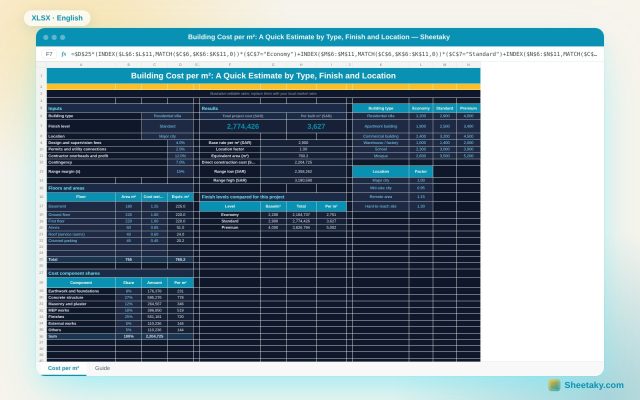
Building Cost per m² Calculator in Excel: A Quick Estimate by Type, Finish and Location
An Excel sheet that estimates building cost per square metre: pick building type, finish level and location, enter…
Quantity takeoff & pricing
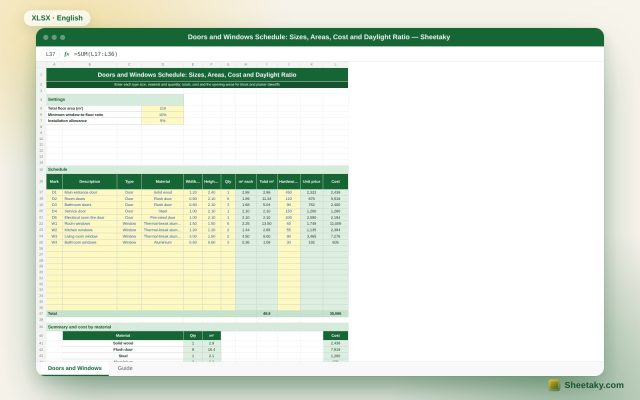
Doors and Windows Schedule in Excel: Sizes, Areas, Cost and Daylight Ratio
An Excel doors and windows schedule: enter mark, material, size and quantity and it computes areas, cost by…
Quantity takeoff & pricing
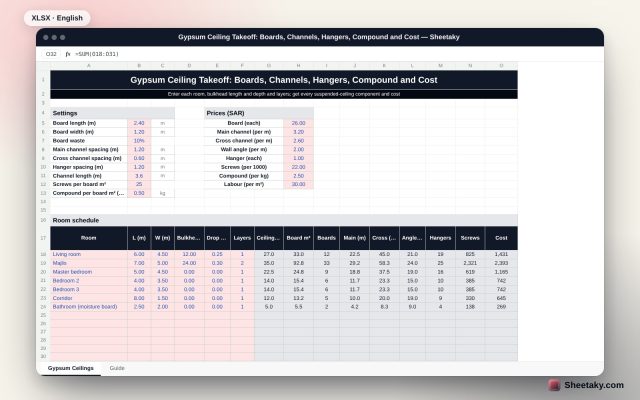
Gypsum Ceiling Takeoff in Excel: Boards, Channels, Hangers, Compound and Cost
An Excel suspended gypsum ceiling takeoff: enter room sizes, bulkhead length and drop and layers and it computes…