Water Tank and Pump Sizing in Excel: Demand, Capacity, Dimensions and Motor
- XLSX
- 11 KB
- Version 1.0
- English
- October 23, 2026
Ready to download
Editable Excel file
This sheet is also available in: العربية
Tank size should not be guessed. A small tank runs dry at peak, and a very large one costs structure and holds stagnant water. Need varies with building type, user count and the days of storage you want.
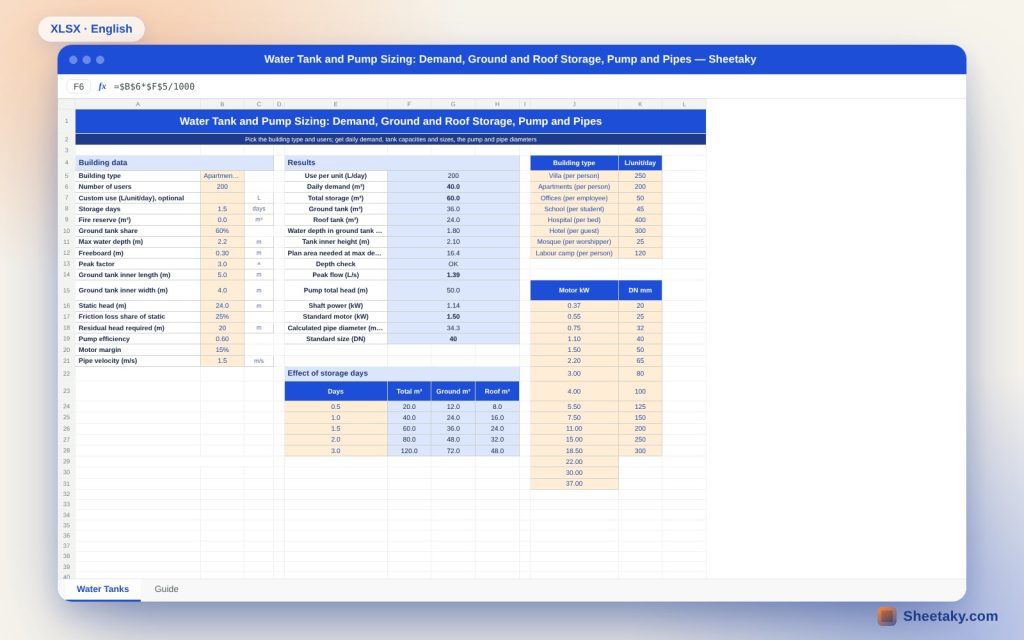
This sheet starts from building type and users to get daily demand, adds storage days and a fire reserve, splits capacity between ground and roof tanks, and checks the water depth in the tank size you propose. Then it computes peak flow, pump head, the standard motor and the pipe diameters.
Who is it for?
- Mechanical, plumbing and civil engineers
- Plumbing contractors
- Owners of residential and commercial buildings
- Facility managers checking tank capacity
What is inside the sheet?
- A building-type list with per-unit use (villa, apartments, offices, school, hospital, hotel, mosque, labour camp)
- An optional custom use, storage days, fire reserve and ground-tank share
- Ground tank size, a water depth check and freeboard
- Peak flow, total head, shaft power and the standard motor
- Calculated and standard pipe diameter from velocity
- A table of how storage days change capacity, a chart and a guide
How to use it
- Pick the building type and enter users.
- Set storage days, fire reserve and ground-tank share.
- Enter the ground tank plan size to check water depth.
- Enter static head and residual head to read the motor and pipe.
Formulas used
Daily demand = users × L per unit ÷ 1000Storage = demand × storage days + fire reserveWater depth = tank volume ÷ (length × width)Peak flow (L/s) = demand × peak factor ÷ 24 ÷ 3.6Shaft power = Q × H × 9.81 ÷ efficiencyDiameter = √(4Q ÷ (π × velocity))
Worked example from the sheet itself
A 40-apartment building with 200 residents using 200 L per person.
- Daily demand is 40 m³ and 1.5 days of storage is 60 m³: 36 m³ ground and 24 m³ roof.
- A 5×4 m ground tank gives a water depth of 1.8 m and a total inner height of 2.1 m with 0.3 m freeboard.
- Peak flow is 1.39 L/s and pump head 50 m (24 m static + 25% friction + 20 m residual), so shaft power is 1.14 kW, the standard motor 1.5 kW and the pipe DN40.
Storage days
A day and a half of storage suits most residential buildings in cities with limited outages, while remote sites or critical services may need 3 days. The table shows the effect of each option on total, ground and roof capacity.
Ground and roof tanks
The ground tank takes most of the storage and is fed from the mains, while the roof tank reduces pump starts. 60% ground and 40% roof is an example, so set it to your local code and building structure.
Water depth and freeboard
The sheet checks the depth produced by your plan size against the maximum and tells you to enlarge the plan if it is exceeded. Freeboard above the water level holds the float valve and ventilation.
Peak flow and pump
Peak flow here is an estimate using a peak factor over the average. For large buildings use the fixture-unit method. A 15% margin is added to the motor before choosing the standard size.
Tips for best results
- Ask the water authority about permitted capacity.
- Leave a cleaning hatch and ventilation in each tank.
- Use real pump prices from the supplier.
- Review pressure calculations with a plumbing engineer.
Frequently asked questions
Can I enter a custom use?
Yes, in the optional custom use field.
Does it include a fire reserve?
You enter it in its field in cubic metres.
Is the motor final?
It is a standard preliminary choice; the supplier confirms it from the pump curve.
Does it work for mixed-use buildings?
Calculate each part separately and add the capacities.
Download the sheet
Press the download button at the top of the page to get the Excel file. It includes a full guide sheet, yellow input cells and formulas protected from accidental edits. The sheet is also available in Arabic from the language switcher.
A preliminary result for a plumbing engineer to confirm against local code.
Related sheets
Civil & structural
Staircase Calculator in Excel: Risers, Riser Height, Going, Angle and Concrete
An Excel sheet that designs a stair: from the floor height it proposes the riser count using Blondel…
Civil & structural
Plastering Takeoff in Excel: Wall, Ceiling and Facade Areas and Mortar
An Excel sheet for interior and exterior plaster takeoff: it computes wall and ceiling areas from room and…
Civil & structural
Block Masonry Takeoff in Excel: Blocks, Mortar, Cement, Sand and Cost
An Excel sheet for block masonry takeoff: enter walls, thicknesses and openings and it gives block count, mortar,…