Block Masonry Takeoff in Excel: Blocks, Mortar, Cement, Sand and Cost
- XLSX
- 13 KB
- Version 1.0
- English
- October 23, 2026
Ready to download
Editable Excel file
This sheet is also available in: العربية
Ordering more blocks than needed leaves stock and breakage, and ordering fewer stops the mason. Mortar changes with wall thickness, block size and joint thickness, so a “so many blocks per square metre” rule is not enough.
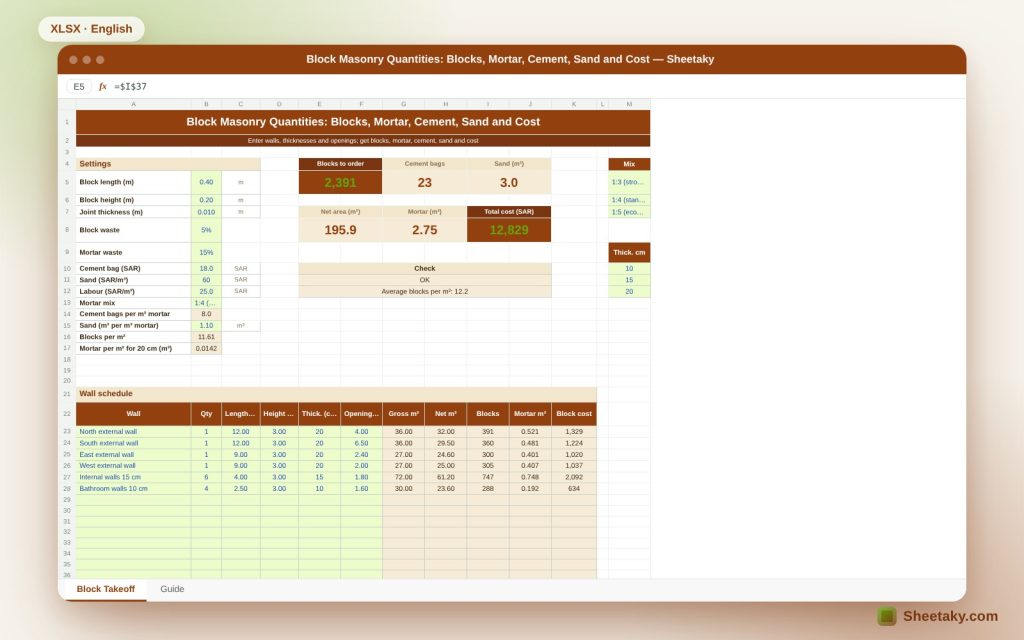
This sheet computes block count from block size and joint thickness, then the mortar each wall needs by its thickness and waste, converts it to cement bags and sand, and adds block cost by thickness plus labour.
Who is it for?
- Building contractors and site supervisors
- Quantity surveyors and estimators
- Owners buying materials directly
- Students doing takeoff projects
What is inside the sheet?
- Block size, joint thickness, block and mortar waste
- A mortar mix list (1:3, 1:4, 1:5) with cement bags per m³
- An editable table of thicknesses and block prices
- A 14-wall table with quantity, length, height, thickness and openings
- Blocks, mortar and block cost for each wall
- Cards for blocks, cement, sand, area, mortar and cost
- An openings check, a chart and a guide
How to use it
- Set block size and joint thickness and pick a mortar mix.
- Enter each wall: quantity, length, height and pick a thickness from the list.
- Enter the opening area for doors and windows.
- Read the quantities and cost.
Formulas used
Blocks per m² = 1 ÷ ((block length + joint) × (block height + joint))Net area = quantity × length × height − openingsBlock count = area × blocks per m² × (1 + waste)Mortar per m² = blocks per m² × [(L+j)(H+j) − L×H] × thicknessCement = mortar × bags/m³, sand = mortar × m³ sand per m³
Worked example from the sheet itself
Six wall lines: four external 20 cm walls of 126 m² gross with 14.9 m² openings, internal 15 cm walls six times 4 m long and 10 cm bathroom walls four times.
- Net area is 195.9 m², or 2,391 blocks, an average 12.2 blocks per m² including waste.
- Mortar is 2.75 m³ at 1:4, which is 23 cement bags and 3.0 m³ of sand.
- Total cost is 12,829: blocks 7,336, cement 414, sand 182 and labour 4,898.
Why “12.5 blocks per m²” is not enough
That figure suits a 40×20 block with about a 1 cm joint, but it changes with the actual block size and joint. The sheet computes it from the dimensions you enter (11.6 for a 40×20 block with a 1 cm joint) and then adds waste.
Mortar by thickness
Mortar in a 20 cm wall is roughly double that of a 10 cm wall because the bed is wider. The sheet computes the volume from the gap between blocks for each thickness.
Mortar mix
A 1:3 mix is stronger but needs more cement. Pick the mix from the list and edit the cement bags per m³ to match your specification; they are approximate figures.
Openings and columns
Deduct door and window areas in the openings column. Columns and beams are not part of the takeoff; if they sit inside the wall, deduct their area along with the openings.
Tips for best results
- Check real block sizes with the supplier.
- Order 3 to 5% extra for transport breakage.
- Record each wall thickness because it drives price and mortar.
- Use the real height for walls above 3 m.
Frequently asked questions
Can I change the mortar mix?
Yes, from the mix list and the bags-per-m³ table.
Does it cover hollow and solid blocks?
It works from block dimensions; change the price for your type.
How do I deduct openings?
Enter the door and window area for each wall in the openings column.
Is labour fixed?
No, edit it in the settings.
Download the sheet
Press the download button at the top of the page to get the Excel file. It includes a full guide sheet, yellow input cells and formulas protected from accidental edits. The sheet is also available in Arabic from the language switcher.
A quantity estimate; prices and mortar mixes are editable examples.
Related sheets
Civil & structural
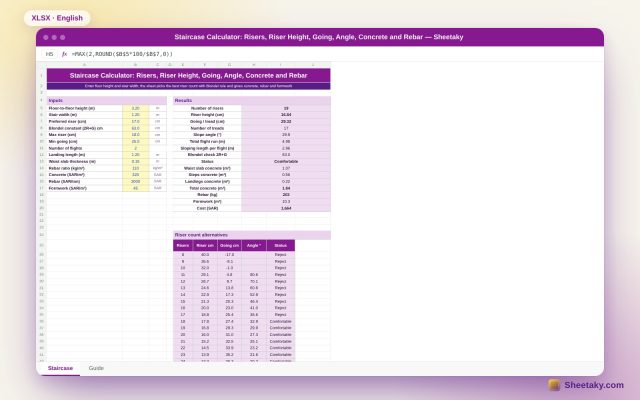
Staircase Calculator in Excel: Risers, Riser Height, Going, Angle and Concrete
An Excel sheet that designs a stair: from the floor height it proposes the riser count using Blondel…
Civil & structural
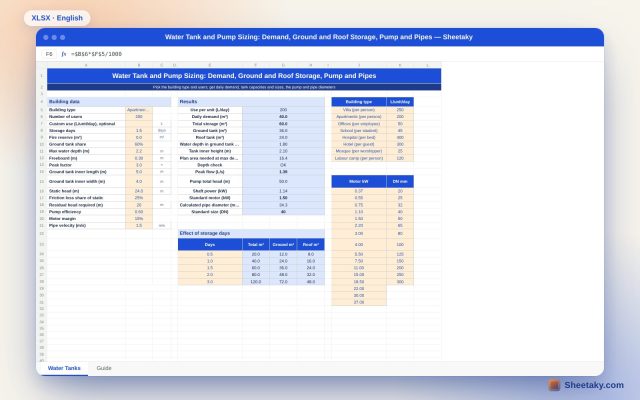
Water Tank and Pump Sizing in Excel: Demand, Capacity, Dimensions and Motor
An Excel sheet that computes a building daily water demand from its type and users, then ground and…
Civil & structural
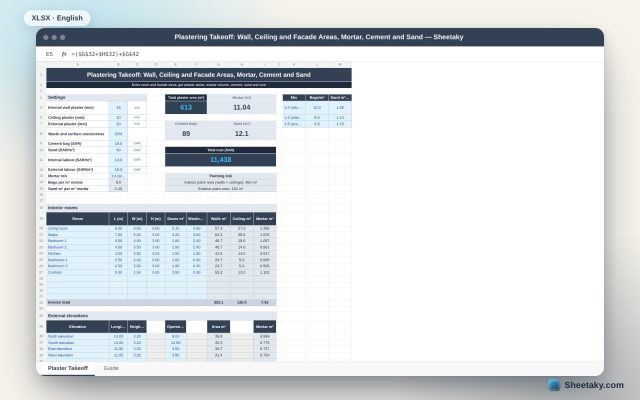
Plastering Takeoff in Excel: Wall, Ceiling and Facade Areas and Mortar
An Excel sheet for interior and exterior plaster takeoff: it computes wall and ceiling areas from room and…