Footing Quantities Sheet in Excel: Concrete, Excavation, Backfill, Rebar, Formwork and Cost
- XLSX
- 13 KB
- Version 1.0
- English
- October 23, 2026
Ready to download
Editable Excel file
This sheet is also available in: العربية
Footing takeoff is the first large takeoff on any building and its errors multiply: short concrete stops the pour, and an exaggerated excavation means extra backfill and haulage. With several footing types (F1, F2, F3, strip, lift pit) a manual tally is slow and error-prone.
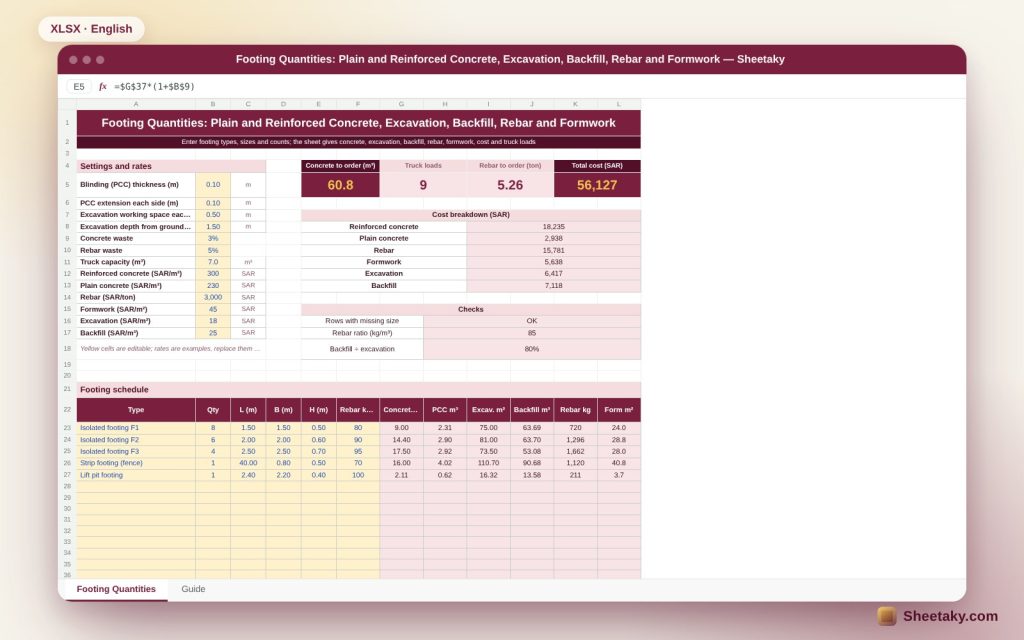
In this sheet you enter each footing type with count, size and rebar ratio. It computes reinforced and plain concrete, excavation with working space, backfill, rebar and formwork, then adds waste and turns everything into a purchase order, truck loads and a detailed cost.
Who is it for?
- Site engineers and technical offices in contracting firms
- Quantity surveyors preparing bills of quantities
- Owners reviewing contractor offers
- Civil engineering students doing takeoff projects
What is inside the sheet?
- Settings: blinding thickness, working space, excavation depth, waste and truck size
- A 14-type footing table with count, length, width, thickness and rebar ratio
- Reinforced and plain concrete, excavation, backfill, rebar and formwork for each type
- Totals and an order quantity with waste and truck loads
- A cost breakdown with data bars and editable rates
- Checks for incomplete rows, rebar ratio and backfill ratio
- A chart of concrete per type and a guide
How to use it
- Set blinding thickness, working space and excavation depth.
- Enter each footing type: count, length, width, thickness and rebar ratio.
- Edit the rates to match your project.
- Read the concrete to order, truck loads, rebar tonnes and cost.
Formulas used
Concrete = count × L × B × HPlain concrete = count × (L + 2×extension) × (B + 2×extension) × its thicknessExcavation = count × (L + 2×working space) × (B + 2×working space) × depthBackfill = excavation − reinforced concrete − plain concreteRebar = concrete × kg/m³, formwork = count × footing perimeter × H
Worked example from the sheet itself
Five types: eight 1.5×1.5×0.5 m footings, six 2×2×0.6, four 2.5×2.5×0.7, a 40×0.8×0.5 fence strip and a 2.4×2.2×0.4 lift pit, excavated 1.5 m deep.
- Reinforced concrete is 59.0 m³, ordering 60.8 m³ with 3% waste, which is 9 trucks of 7 m³.
- Excavation is 356.5 m³, backfill 284.7 m³, rebar 5.0 tonnes (5.26 with waste) and formwork 125 m².
- Total cost is 56,127 at the example rates, led by reinforced concrete 18,235 and rebar 15,781.
Why footing takeoffs multiply errors
Excavation depends on the working space around each footing, so a small allowance on every side grows the volume a lot. In the example footing concrete is 59 m³ but excavation is 356 m³, six times as much. That is why you want excavation and backfill beside the concrete on one page.
Plain concrete
It is placed under the footing to give a clean surface and protect the steel, and usually projects 10 cm each side at 10 cm thick. You can change both values in the settings to follow your specification.
Rebar ratio
Small and large footings differ in kg per m³, so enter each type ratio from your bar schedules. The sheet shows the overall ratio in the checks so you can compare it with your experience: 70 to 110 kg/m³ is common in footings.
Limits of the takeoff
Backfill does not deduct column necks or ground beams, and the sheet excludes waterproofing and retaining walls. Use it for estimating and material orders, and take final steel from detailed bar schedules.
Tips for best results
- Use final footing sizes from the structural drawings.
- Compare backfill to excavation: a very low ratio may signal a dimension error.
- Record supplier rates with dates for later review.
- Keep a copy of the sheet for each project phase.
Frequently asked questions
Does it work for strip footings?
Yes, enter total length in the length column and width in the width column.
Can I add more types?
The table holds 14 types; use a second copy for more.
Are the rates real?
They are editable examples, not an offer.
Does it detail the rebar?
No, it estimates by kg/m³; detailing belongs to bar schedules.
Download the sheet
Press the download button at the top of the page to get the Excel file. It includes a full guide sheet, yellow input cells and formulas protected from accidental edits. The sheet is also available in Arabic from the language switcher.
A preliminary quantity estimate; rates are examples and final steel comes from bar schedules.
Related sheets
Civil & structural
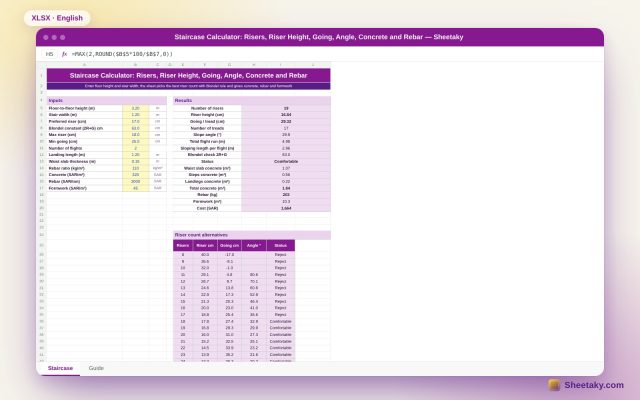
Staircase Calculator in Excel: Risers, Riser Height, Going, Angle and Concrete
An Excel sheet that designs a stair: from the floor height it proposes the riser count using Blondel…
Civil & structural
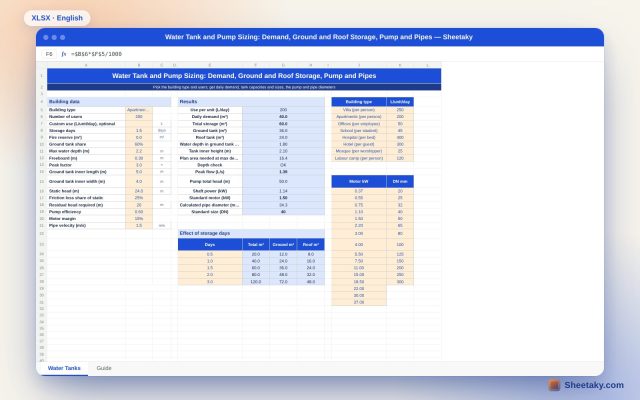
Water Tank and Pump Sizing in Excel: Demand, Capacity, Dimensions and Motor
An Excel sheet that computes a building daily water demand from its type and users, then ground and…
Civil & structural
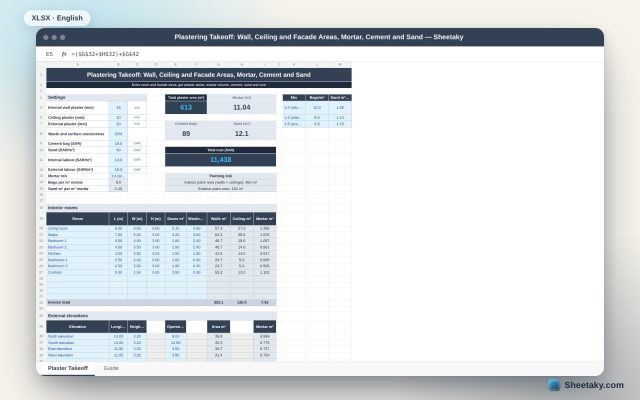
Plastering Takeoff in Excel: Wall, Ceiling and Facade Areas and Mortar
An Excel sheet for interior and exterior plaster takeoff: it computes wall and ceiling areas from room and…