Breaker and Cable Selection Sheet in Excel: Derating, Voltage Drop and Breaking Capacity
- XLSX
- 16 KB
- Version 1.0
- English
- October 23, 2026
Ready to download
Editable Excel file
This sheet is also available in: العربية
Choosing a cable is not one table lookup. The same cable carries less current in hot air, less when several circuits sit together and less in conduit than on an open tray. Then voltage drop on long runs can force a bigger size even when ampacity is enough.
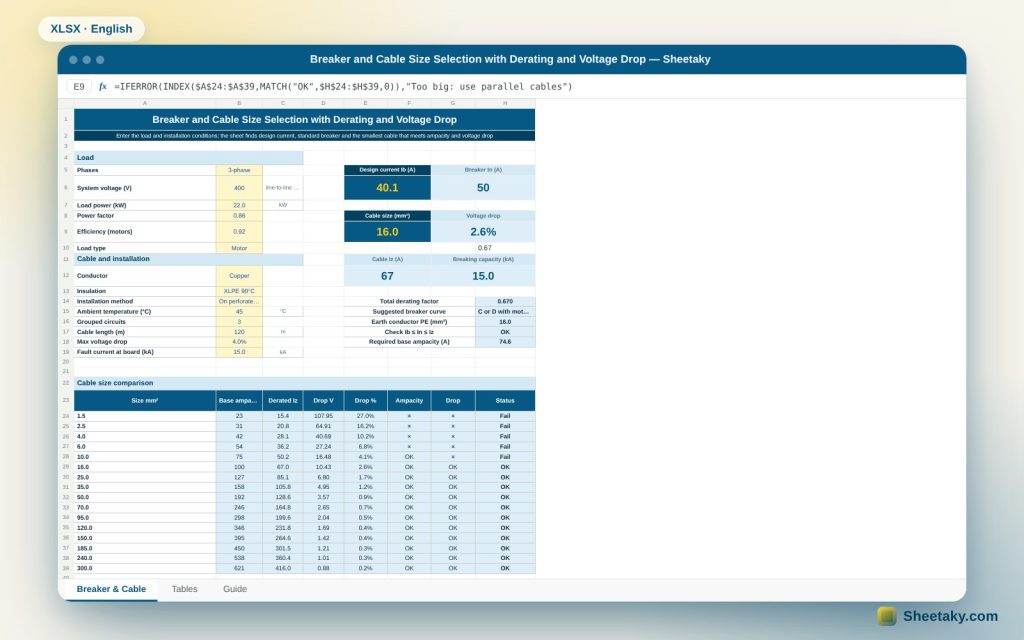
This sheet strings those steps together: it computes design current from power, voltage, power factor and efficiency, picks the next standard breaker, then applies temperature, grouping and installation factors to get the required base ampacity. It compares every cable size from 1.5 to 300 mm² on derated ampacity and voltage drop and highlights the smallest size that passes both.
Who is it for?
- Electrical engineers, designers and site engineers
- Technicians and installation contractors choosing cables and breakers
- Students learning the cable selection steps
- Anyone reviewing a cable size proposed by a supplier or contractor
What is inside the sheet?
- Inputs: phases, voltage, power, power factor, efficiency and load type
- Conductor, insulation, installation method, temperature, grouped circuits, length, voltage-drop limit and fault current
- An editable ampacity reference table (copper and aluminium, PVC and XLPE)
- Tables for temperature, grouping and installation factors, breaker sizes and breaking capacities
- Cards: design current, breaker, cable size, voltage drop, cable Iz and breaking capacity
- A 16-size comparison with ampacity, voltage drop and status plus a chart
- Earth conductor size, suggested breaker curve and an Ib ≤ In ≤ Iz check
How to use it
- Pick phases and enter voltage, power and power factor.
- Pick conductor, insulation and installation method, then enter temperature and grouped circuits.
- Enter length, voltage-drop limit and the fault level at the board.
- Read the breaker and cable and review the comparison table.
Formulas used
Ib = P × 1000 ÷ (√3 × V × PF × η) for three-phaseIn = first standard breaker ≥ Ibk = k temperature × k grouping × k installationRequired base ampacity = In ÷ kVoltage drop = √3 × Ib × L × (ρ ÷ S × cosφ + x × sinφ)Conditions: Ib ≤ In ≤ Iz and drop % ≤ limit
Worked example from the sheet itself
A 22 kW three-phase 400 V motor with power factor 0.86 and efficiency 0.92, on copper XLPE cable on a perforated tray, 120 m long, at 45 °C with 3 grouped circuits.
- Design current is 40.1 A so a 50 A breaker is selected.
- Derating: temperature 0.87 × grouping 0.70 × tray 1.10 = 0.67, so the required base ampacity is 74.6 A.
- 10 mm² (75 A) passes ampacity but its 4.1% drop exceeds 4%, so 16 mm² is chosen (67 A derated, 2.6% drop) with a 16 mm² earth conductor and 15 kA breaking capacity.
Why the sheet rejects a size that has enough ampacity
On long runs voltage drop becomes the governing factor. Low voltage at a motor raises current, heats the windings and cuts torque. That is why the table shows sizes with enough ampacity that still fail on drop.
The three derating factors
- Temperature: ampacity falls as ambient rises above the 30 °C reference, and XLPE tolerates more heat than PVC.
- Grouping: many circuits together reduce heat dissipation and capacity.
- Installation method: a perforated tray runs cooler than conduit buried in a wall.
Earth conductor and breaker curve
The sheet suggests the earth size as the same size up to 16 mm², 16 mm² up to 35 mm², then half the phase size. For motors it suggests curve C or D with motor protection, and B or C for lighting and heaters.
Limits of the sheet
The ampacity values on the Tables sheet are approximate references in the style of IEC 60364-5-52 for method C, so adjust them to your local code and manufacturer data. The sheet does not replace a short-circuit withstand and discrimination check.
Tips for best results
- Check the cable data sheet from the manufacturer.
- Use the real cable length, not an estimate.
- For very large sizes think about two cables in parallel.
- Keep the calculation for the consultant review.
Frequently asked questions
What is the difference between In and Iz?
In is the breaker rating, Iz the real cable capacity after derating; In must not exceed Iz.
Does it work for single-phase circuits?
Yes, pick single-phase and enter 230 V.
Can I edit the tables?
Yes, the Tables sheet is editable.
Does it replace the code?
No, it is a preliminary selection tool.
Download the sheet
Press the download button at the top of the page to get the Excel file. It includes a full guide sheet, yellow input cells and formulas protected from accidental edits. The sheet is also available in Arabic from the language switcher.
A preliminary selection tool; check against local code and manufacturer data.
Related sheets
Electrical engineering
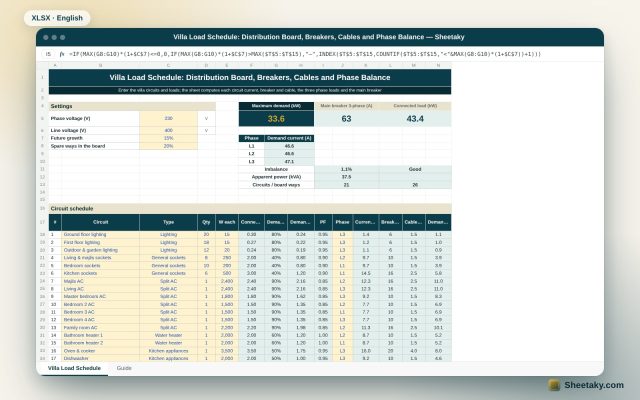
Villa Load Schedule in Excel: Distribution Board, Breakers, Cables and Phase Balance
An Excel villa load schedule: enter the circuits and it computes each circuit current, breaker and cable, sums…
Electrical engineering
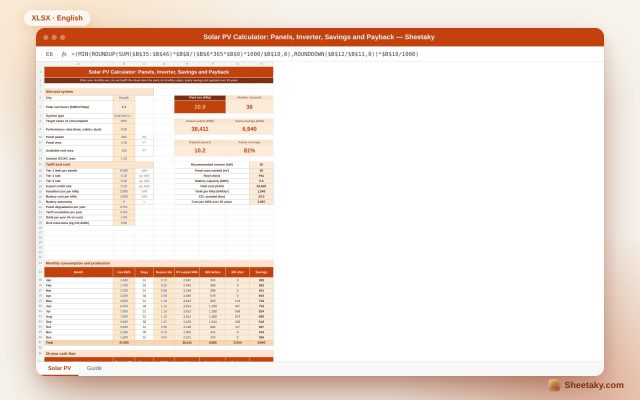
Solar PV Calculator in Excel: Panels, Inverter, Savings and Payback
An Excel sheet that sizes a solar plant from your monthly use and city: panels, inverter, monthly output,…
Electrical engineering
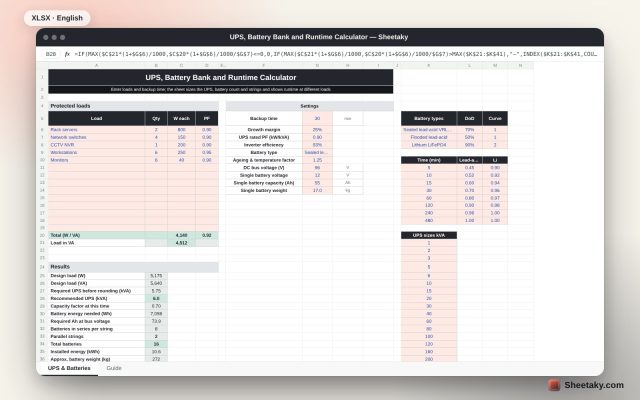
UPS, Battery Bank and Runtime Calculator in Excel
An Excel sheet that sizes a UPS from your loads, then the batteries and strings for your backup…