Generator Sizing Calculator in Excel: kVA with Motor Starting, Heat and Altitude Derating
- XLSX
- 14 KB
- Version 1.0
- English
- October 23, 2026
Ready to download
Editable Excel file
This sheet is also available in: العربية
A generator that is too small trips the building the first time a big pump starts; one that is too large costs more, wastes fuel and runs on a light load that harms the engine. The right size comes from two checks, not one: the continuous load with a growth margin, and the worst motor start.
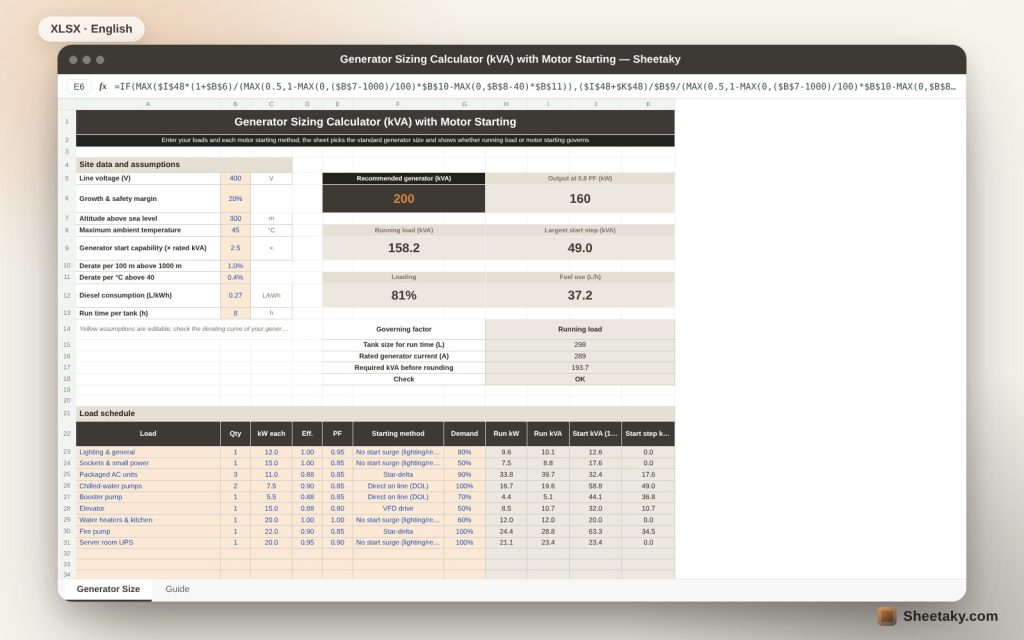
This sheet puts your loads in one table: quantity, kW each, efficiency, power factor, starting method and demand factor. It calculates running kVA and the start step of each load, applies altitude and temperature derating, and shows the recommended standard generator and whether running load or starting governs.
Who is it for?
- Electrical engineers and contractors preparing generator offers
- Owners of buildings, villas and small facilities choosing a standby set
- Maintenance managers checking whether a generator still copes after adding load
- Anyone comparing direct-on-line, star-delta and soft-starter options to save generator size
What is inside the sheet?
- A table of up to 25 loads: quantity, kW, efficiency, power factor, starting method and demand factor
- Running kW and kVA, start kVA and the start step for every load
- Site settings: voltage, growth margin, altitude, temperature and generator start capability
- Editable starting-method multipliers and a list of standard generator sizes
- Cards: recommended generator, kW, running load, largest start step, loading and fuel use
- Governing factor, tank size, generator current and a warning under 30% or over 85% loading
- A kVA-per-load chart and a guide sheet
How to use it
- Set voltage, growth margin, altitude and temperature in the settings.
- Enter each load with quantity, kW each, efficiency and power factor.
- Pick each motor starting method and the demand factor (the share running at the same time).
- Read the recommended generator, then try another starting method for the largest motor to see the effect.
- Print the sheet or send it to the supplier with your data.
Formulas used
Running kVA = (qty × kW ÷ efficiency) ÷ PF × demand factorUnit start kVA = kW ÷ (efficiency × PF) × starting multiplierStart step = unit start kVA − unit running kVADerating factor = 1 − altitude derate − temperature derateRequired for running = total kVA × (1 + margin) ÷ derating factorRequired for starting = (total kVA + largest start step) ÷ start capability ÷ derating factor
Worked example from the sheet itself
A small commercial building with nine load lines: lighting 12 kW, sockets 15 kW, three 11 kW AC units on star-delta, two 7.5 kW DOL pumps, a booster pump, a VFD elevator, 20 kW heaters, a 22 kW fire pump and a 20 kW UPS.
- Total running load is 158.2 kVA (137.9 kW) and the largest start step is 49.0 kVA, from a 7.5 kW direct-on-line pump.
- At 300 m altitude and 45 °C the derating factor is 0.98; the running requirement is 193.7 kVA against 84.6 kVA for starting, so running governs.
- Result: a 200 kVA (160 kW) generator at 81% loading, using about 37.2 L/h, with a 298 L tank for 8 hours.
Why not just add the loads and buy the generator?
Installed loads do not all run at once, so lighting, sockets and air conditioning have demand factors below one. Ignoring them inflates the size; applying them carelessly shrinks it. The sheet asks for a factor on each load and shows its effect.
More importantly, running load is not the hardest test. The toughest moment is starting a big motor: direct-on-line starting current can reach six times rated current, and the generator voltage dips if the set is not big enough.
How to reduce the size without risk
Change the largest motor from direct-on-line to star-delta, soft starter or VFD and watch the kVA required for starting fall. Starting motors one after another instead of together also helps.
- Stagger the start of large motors.
- Shed non-critical loads while on generator.
- Do not size to 90% continuous loading: a generator needs room to grow.
Altitude and heat
Diesel engines lose power above 1000 m and in high heat. The sheet has two editable percentages (derate per 100 m above 1000 m and per °C above 40); replace them with your manufacturer curve.
Generator loading: neither too high nor too low
Running under 30% load often causes carbon build-up and engine damage, while over 85% leaves little margin. The sheet warns you when loading leaves that band.
Tips for best results
- Use motor nameplate data instead of guesses.
- Add future loads through the growth margin, not inflated numbers.
- Ask the supplier for the derating curve at your site conditions.
- Calculate fuel for the real load, not full load.
Frequently asked questions
Does the sheet replace an engineer calculation?
It is an accurate preliminary tool, but the final set should be confirmed with manufacturer curves and an electrical engineer.
What does a start capability of 2.5 mean?
The generator can momentarily supply up to 2.5 times its rated current before its voltage drops significantly. Change it to your manufacturer value.
Does it work for other voltages?
Yes, change the line voltage in the settings.
How many loads fit?
25 loads, and you can edit starting methods and standard sizes.
Download the sheet
Press the download button at the top of the page to get the Excel file. It includes a full guide sheet, yellow input cells and formulas protected from accidental edits. The sheet is also available in Arabic from the language switcher.
Results are preliminary estimates; confirm them with manufacturer data and an electrical engineer.
Related sheets
Electrical engineering
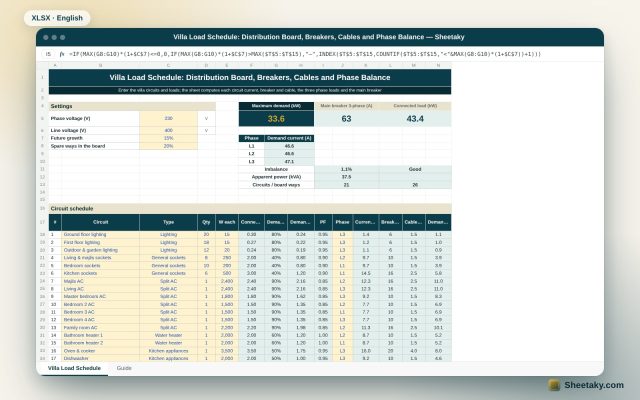
Villa Load Schedule in Excel: Distribution Board, Breakers, Cables and Phase Balance
An Excel villa load schedule: enter the circuits and it computes each circuit current, breaker and cable, sums…
Electrical engineering
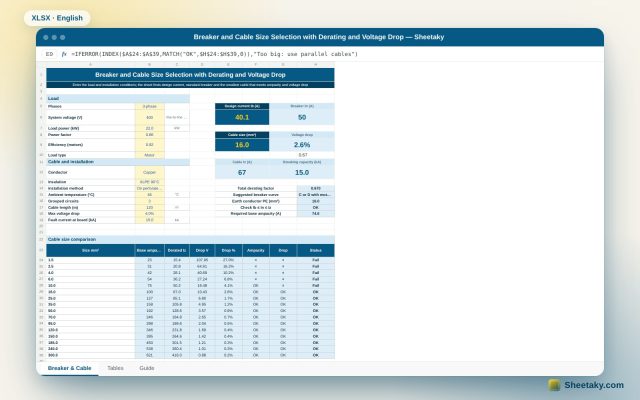
Breaker and Cable Selection Sheet in Excel: Derating, Voltage Drop and Breaking Capacity
An Excel sheet that computes design current, picks the standard breaker, applies temperature, grouping and installation factors to…
Electrical engineering
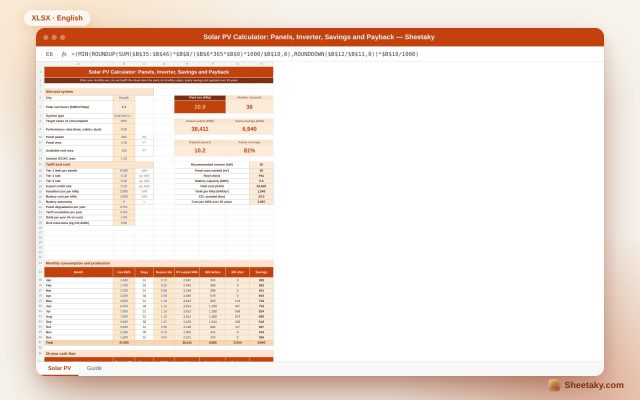
Solar PV Calculator in Excel: Panels, Inverter, Savings and Payback
An Excel sheet that sizes a solar plant from your monthly use and city: panels, inverter, monthly output,…