Finishes and Tiles Takeoff, Room by Room
- Ziad Eltaky
- 2 min read
- October 23, 2026
The easiest way to take off finishes without missing an item is a room schedule: one row per room, with columns for area, perimeter, height and the finish for each surface. Then you total the columns instead of measuring the drawing ten times.
Step 1: Data for each room
Record length, width and height, then calculate:
- Floor area = length × width.
- Perimeter = 2 × (length + width).
- Wall area = perimeter × height − door and window openings.
- Ceiling area = usually the floor area.
Step 2: Floor tiles
Number of tiles = floor area ÷ tile area, then add waste.
Example: a 4.0 × 5.0 m room = 20 m², 60 × 60 cm tiles (0.36 m²):
- 20 ÷ 0.36 = 55.6 tiles
- With 10% waste (cuts and breakage): 55.6 × 1.10 ≈ 61.1, so order 62 tiles, about 22.3 m²
Waste is higher for diagonal layouts, patterns and small rooms, and lower for big halls with straight lay (5% can be enough). Order tiles from the same batch to avoid shade differences.
Step 3: Skirting
Length = perimeter − door widths. Divide by the piece length (for example 60 cm or 120 cm) and add a small allowance.
Step 4: Walls and paint
Paint area = wall area + ceiling. Multiply by the number of coats (usually putty and two coats). Coverage per litre depends on the product and surface roughness. Most datasheets quote 8 to 12 m² per litre per coat, so check the data sheet of the product you will use.
Step 5: Plaster and wall tiles
Tiled walls (bathrooms, kitchens) are deducted from paint and added to wall tiles at their actual height. Plaster is measured on the same surface area before deducting large openings, according to the measurement method in the contract.
Deduction rule
Opening deduction rules differ between measurement standards and contracts. A common practice is to deduct openings larger than about half a square metre, but read the contract instead of assuming.
Ready tools
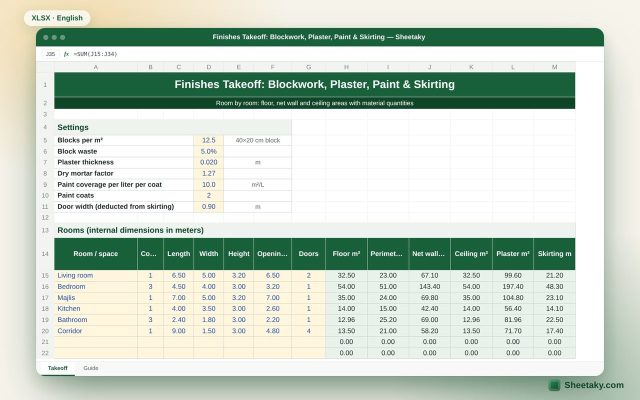
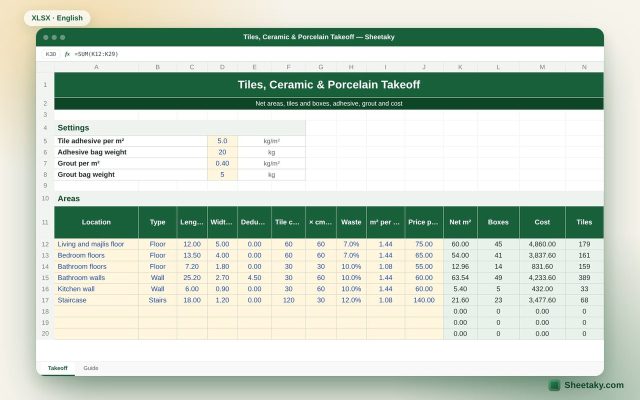
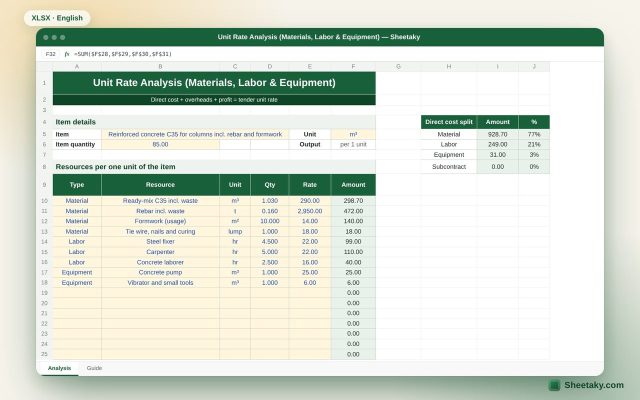
All of the above is ready with formulas in the finishes takeoff sheet and the tiles takeoff sheet. Once you have quantities, move on to pricing with the unit rate analysis sheet.
Download the related sheets
Quantity takeoff & pricing
Finishes Takeoff Excel Sheet: Blockwork, Plaster, Paint and Skirting per Room
An Excel takeoff for finishes room by room: floor area, net walls after openings, ceilings, plaster and skirting,…
Quantity takeoff & pricing
Tiles Takeoff Excel Sheet: Ceramic and Porcelain Boxes, Adhesive and Cost
An Excel tile takeoff per location: net area after deductions, tiles and boxes with waste, adhesive and grout…
Quantity takeoff & pricing
Unit Rate Analysis Excel Sheet for Construction Items: Materials, Labor, Equipment and Profit
An Excel sheet to build the unit rate of any BOQ item: resources per unit (materials, labor, equipment,…
Get every new sheet and guide
A short, useful email when a new sheet or guide is added. Unsubscribe any time.