Unit Rate Analysis: How to Price a Contracting Item Properly
- Ziad Eltaky
- 2 min read
- October 23, 2026
The unit rate is the number that makes or loses you money. A contractor who prices by guesswork may profit by luck, but one who breaks the rate into components knows where to cut and where the loss begins. This guide explains the method with one example from start to finish.
Components of a rate
- Materials: quantity per unit × price, plus waste.
- Labour: daily wage ÷ daily output in units.
- Equipment: hire or depreciation ÷ output.
- Subcontract: if the item is let out.
- Overheads: a percentage of direct cost (office, site, insurance, guarantees).
- Profit: a percentage on top.
- Risk allowance: where there are uncertain factors.
Example: floor tile installation (rate per m²)
Prices are assumed for explanation only. Replace them with your market prices:
| Component | Calculation | Cost (SAR/m²) |
|---|---|---|
| Tiles | 1.07 m² (7% waste) × 60 SAR | 64.2 |
| Adhesive and mortar | 5 kg × 1.2 SAR | 6.0 |
| Labour | (tiler 120 + helper 70) ÷ output 12 m²/day | 15.8 |
| Equipment and tools | estimated | 1.0 |
| Direct cost | 87.0 | |
| Overheads | 10% of direct | 8.7 |
| Profit | 10% of (direct + overheads) | 9.6 |
| Unit rate | ≈ 105.3 |
For 500 m² the tiling item comes to about 52,650 SAR before tax.
Where mistakes usually happen
- Productivity: the riskiest number. Optimistic output means cheaper labour on paper and a loss on site. Measure your crews’ real output.
- Waste: forgetting it eats the profit.
- Supporting work: cleaning, vertical transport, storage and protection do not appear in quantities but they cost money.
- Tax: treated according to your country’s rules (such as VAT) and usually added separately in the quotation.
Link the analysis to the bill of quantities
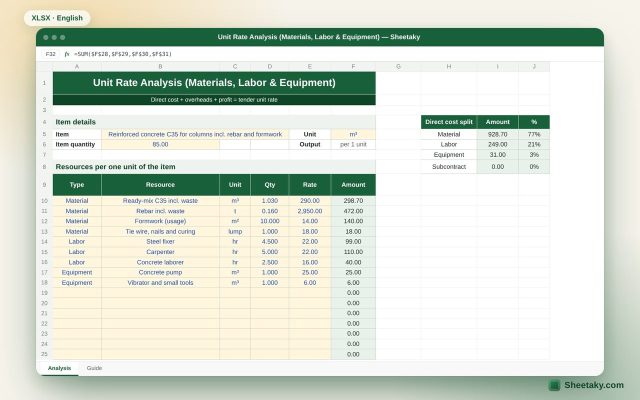
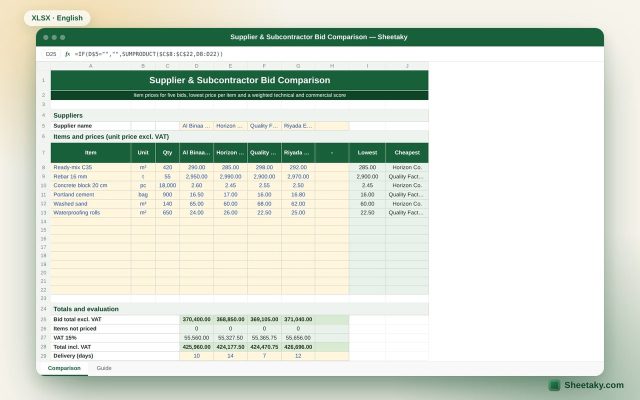
After analysing the main items, multiply them by the quantities from the bill of quantities to reach the total tender value. The analysis itself is ready with formulas in the unit rate analysis sheet, and when several quotes arrive, compare them with the bid comparison sheet.
Download the related sheets
Quantity takeoff & pricing
Unit Rate Analysis Excel Sheet for Construction Items: Materials, Labor, Equipment and Profit
An Excel sheet to build the unit rate of any BOQ item: resources per unit (materials, labor, equipment,…

Quantity takeoff & pricing
BOQ Template in Excel: Bill of Quantities with VAT
A Bill of Quantities template in Excel that calculates each item total, the subtotal, 15% VAT and the…
Quantity takeoff & pricing
Supplier and Subcontractor Bid Comparison Excel Sheet with Weighted Scoring
An Excel bid tabulation: five suppliers side by side, the lowest price per item, totals with VAT, and…
Get every new sheet and guide
A short, useful email when a new sheet or guide is added. Unsubscribe any time.