Cable Sizing and Voltage Drop Calculation
- Ziad Eltaky
- 2 min read
- October 23, 2026
Choosing a cable is not just picking the closest size that carries the current. A cable has to pass three tests: thermal capacity, voltage drop and short-circuit withstand. On long runs voltage drop usually decides the size.
First: the load current
Start with the load current, or the rating of the breaker that will protect the cable (see the board load calculation guide). In our example it is 76.4 A on a 400 V three-phase load, with a 100 A breaker.
Second: thermal capacity and correction factors
Code tables give the current rating of each size under reference conditions. Multiply it by correction factors for:
- Ambient temperature: very important in hot climates. A hot ceiling void or direct sun lowers capacity noticeably.
- Grouping: the closer cables sit, the less they can cool.
- Installation method: buried duct, tray or free air.
The corrected rating must be at least the protective device or load current, as your code requires.
Third: voltage drop
For a three-phase circuit:
ΔV = √3 × I × L × (R·cosφ + X·sinφ)
L is the length in kilometres, and R and X are the resistance and reactance in ohms per kilometre from the cable datasheet. Drop percentage = ΔV ÷ line voltage × 100.
Example: I = 76.4 A, length 60 m (0.06 km), 35 mm² copper with R ≈ 0.668 and X ≈ 0.08 ohm/km, cosφ = 0.85 so sinφ ≈ 0.527:
- R·cosφ = 0.568 and X·sinφ = 0.042, total 0.610
- ΔV = 1.732 × 76.4 × 0.06 × 0.610 ≈ 4.84 V
- Percentage = 4.84 ÷ 400 ≈ 1.2%
That is acceptable under most codes. Limits differ, commonly around 3% for final circuits and 5% overall from the source, so check your code.
Fourth: short-circuit withstand
The cable must withstand the fault energy for the time the breaker takes to clear it. On short cables near transformers this can be the deciding check instead of the load.
Practical tips
- If the drop is too high, go up one size and recalculate. Resistance falls roughly in proportion to the cross-section.
- Use the cable resistance at operating temperature, not at 20 °C.
- Check tray or conduit fill after choosing sizes. Try the cable tray fill sheet.
The ready sheet
Enter current, length and cable type in the cable voltage drop sheet to get the percentage at once and compare several sizes. Numbers here are illustrative, so refer to the manufacturer datasheet and your adopted code.
Download the related sheets

Electrical engineering
Cable Voltage Drop Calculator in Excel for Multiple Circuits
An Excel sheet that checks voltage drop in several circuits at once from current, length and mV/A/m, compared…
Electrical engineering
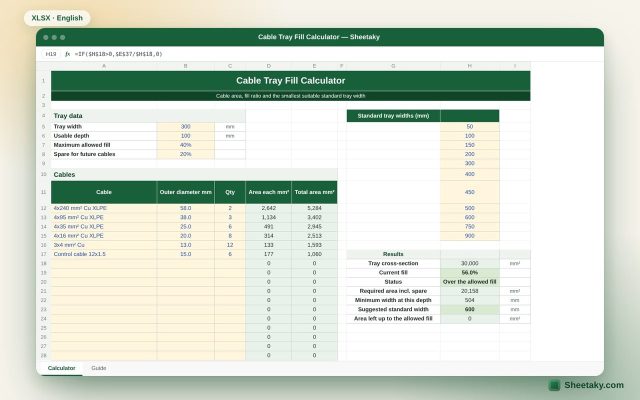
Cable Tray Fill Calculator in Excel: Fill Ratio and Tray Width
An Excel sheet that adds up the cable areas in a tray, calculates the fill ratio, compares it…

Electrical engineering
Electrical Load Calculator in Excel: Current and Transformer Size
A ready Excel sheet to calculate electrical loads with demand factor and power factor, returning current, kVA and…
Get every new sheet and guide
A short, useful email when a new sheet or guide is added. Unsubscribe any time.