Transformer Short-Circuit Current & Breaker Rating Calculator in Excel
- XLSX
- 11 KB
- Version 1.0
- English
Ready to download
Editable Excel file
This sheet is also available in: العربية
Choosing the main breaker after a transformer is not only about rated current. Its breaking capacity (kA) must exceed the prospective short-circuit current at the transformer terminals, or the breaker may fail to clear a fault safely.
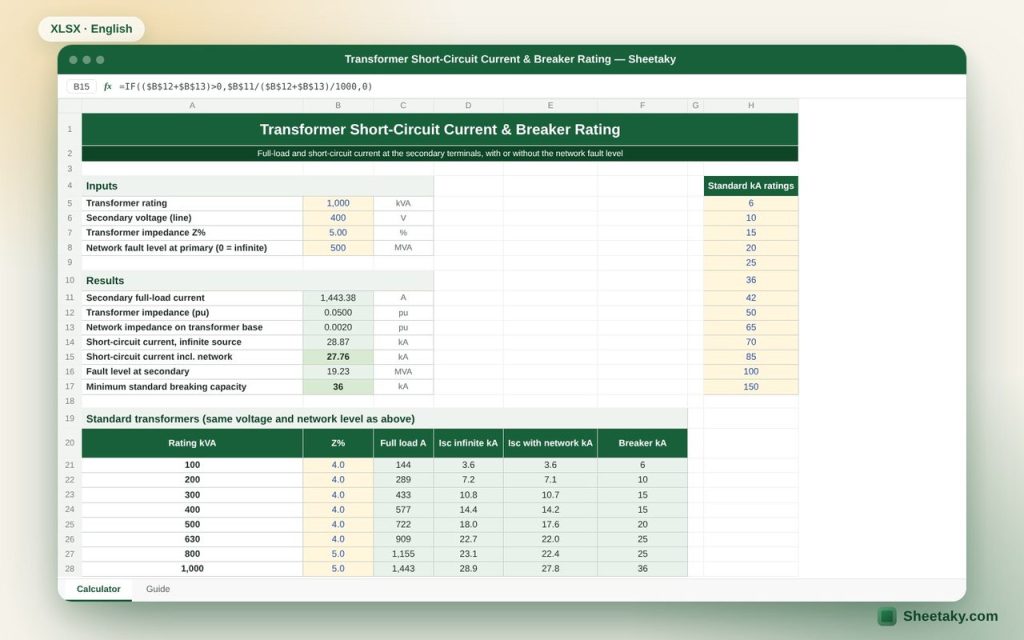
This sheet calculates the three-phase short-circuit current from the transformer rating, voltage and impedance Z%, adds the network impedance if the utility gives you the fault level, suggests the nearest standard breaking capacity, and shows a ready table for transformers from 100 to 2500 kVA.
Who is it for?
- Low-voltage panel designers
- Project engineers reviewing breaker submittals
- Electrical engineering students practicing the calculation
What is inside the sheet?
- Secondary full-load current
- Short-circuit current with an infinite source and with the network impedance
- Fault level at the secondary in MVA
- Minimum standard breaking capacity from an editable list
- A table of thirteen common transformer sizes with editable typical Z%
How to use it
- Enter the transformer rating in kVA and the secondary voltage.
- Enter the impedance Z% from the nameplate.
- Enter the network fault level in MVA if known, or 0 for the worst case.
- Read the short-circuit current and suggested breaking capacity, and use the table to compare.
Formulas used
Full-load current I = S × 1000 ÷ (√3 × V)Network impedance (pu) = (kVA ÷ 1000) ÷ MVAShort-circuit current Isc = I ÷ (Z%/100 + network impedance)
Worked example from the sheet itself
A 1000 kVA transformer, 400 V secondary, 5% impedance, network fault level 500 MVA:
- Full-load current is 1443 A. The short-circuit current is 28.87 kA with an infinite source and 27.76 kA including the network.
- The minimum standard breaking capacity for the main breaker is 36 kA.
Tips for best results
- If you do not know the network fault level, enter 0 to get the worst case.
- Fault current at sub-panels is lower because of cable impedance, so do not use this value for every breaker.
- Large motors add current at the moment of the fault; check them in industrial projects.
Frequently asked questions
What is the difference between Icu and Ics?
Icu is the maximum fault current the breaker can interrupt; Ics is the current it can interrupt and stay in service. Ideally Ics also exceeds the calculated value.
Where do I find the transformer Z%?
On the nameplate or test certificate. The values in the table are typical, for comparison only.
Does it calculate single-phase faults?
No, it calculates the symmetrical three-phase fault at the transformer terminals.
Download the sheet
Press the download button at the top of the page to get the Excel file. It includes a full guide sheet, yellow input cells and formulas protected from accidental edits. The sheet is also available in Arabic from the language switcher.
Calculated at the transformer terminals, ignoring cable impedance and motor contribution. A qualified engineer should do a detailed short-circuit study.
Related sheets
Engineering sheets
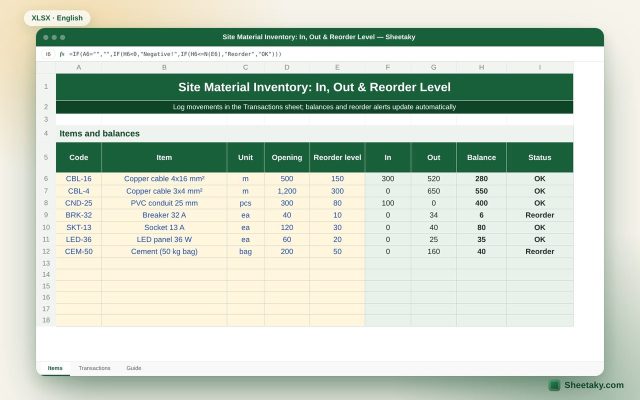
Site Material Inventory in Excel: In, Out, Balance & Reorder Level
An Excel sheet for site store stock: an items list and an IN/OUT log. It calculates current balances…
Engineering sheets
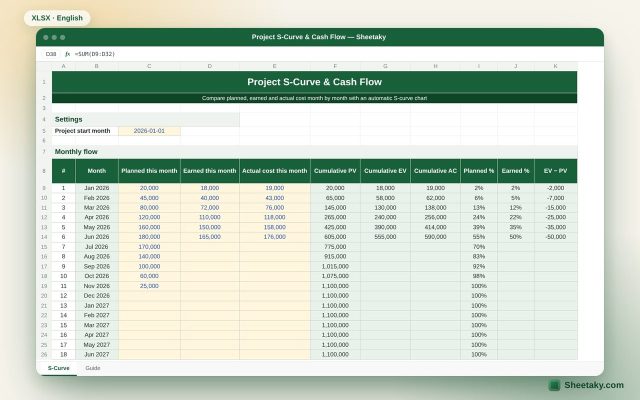
Project S-Curve & Cash Flow in Excel with Automatic Chart
An Excel sheet that draws the project S-curve from monthly planned, earned and actual cost, and calculates cumulative…
Engineering sheets
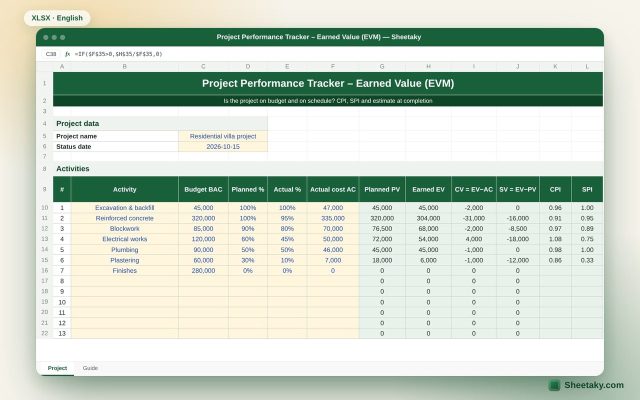
Earned Value Management (EVM) Tracker in Excel: CPI, SPI and EAC
An Excel sheet to measure project performance with earned value: PV, EV and AC per activity, CPI and…