Power Factor Correction Calculator in Excel: Capacitor Bank Sizing (kVAR)
- XLSX
- 12 KB
- Version 1.0
- English
Ready to download
Editable Excel file
This sheet is also available in: العربية
A low power factor means more current in cables and transformers for the same real power. That raises losses and uses capacity you could give to extra loads. The usual fix is a capacitor bank, and the first question is always: how many kVAR do I need?
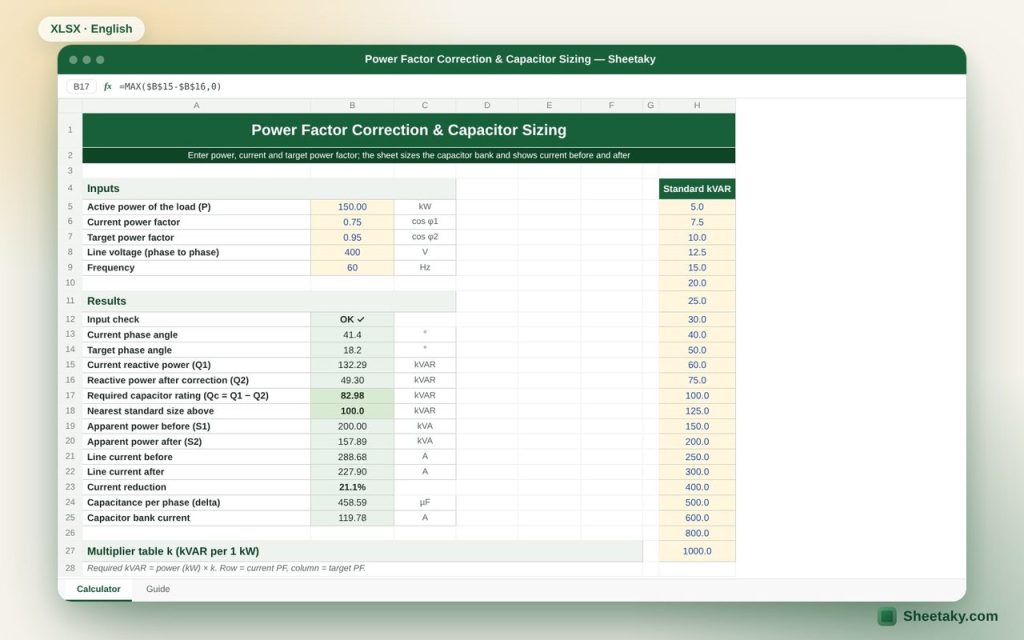
This sheet answers it in seconds. Enter the power and the current and target power factor, and it calculates reactive power before and after, the required capacitor rating, the nearest standard size above it, the current before and after, and the capacitance per phase in microfarads.
Who is it for?
- Electrical engineers and panel designers
- Electrical contractors pricing capacitor banks
- Maintenance staff in factories and commercial buildings
What is inside the sheet?
- Clear inputs: real power, current and target PF, voltage, frequency
- Q1, Q2 and the required capacitor rating Qc
- Nearest standard size from an editable list
- Current and apparent power before and after, and the reduction
- Capacitance per phase (delta) and bank current
- k-factor table for common power factors
- Automatic warning if the target PF is lower than the current one
- A guide sheet in English
How to use it
- Enter the real power of the load in kW from a meter reading or the load schedule.
- Enter the current power factor from the bill or a meter, and the target (usually 0.95).
- Enter the line voltage and frequency.
- Read the required kVAR and the suggested standard size, and check the current after correction.
Formulas used
Q1 = P × tan(φ1), Q2 = P × tan(φ2)Qc = Q1 − Q2 = P × (tan φ1 − tan φ2)I = S × 1000 ÷ (√3 × V), where S = P ÷ cos φC (per phase, delta) = Qc ÷ (3 × 2πf × V²)
Worked example from the sheet itself
A 150 kW load at 0.75 power factor, 400 V and 60 Hz, to be raised to 0.95:
- Reactive power is 132.29 kVAR now and 49.30 kVAR after correction, so the bank needs 82.98 kVAR. The nearest standard size above is 100 kVAR.
- Line current drops from 288.7 A to 227.9 A, a 21.1% reduction, and the capacitance per phase is 458.6 µF.
Tips for best results
- Split the bank into steps with a power factor controller when the load changes during the day.
- Do not push the PF above about 0.98, or light loads may turn capacitive.
- If you have many electronic loads (drives, UPS), study harmonics before choosing the capacitors.
Frequently asked questions
What is the difference between kW, kVAR and kVA?
kW is real power that does the work, kVAR is reactive power for magnetic fields, and kVA is the apparent power that cables and transformers carry.
Why does the sheet suggest a size larger than the result?
Banks come in standard sizes, so the sheet picks the nearest size above the calculated value. You can edit the list in column H.
Does it work for single-phase systems?
The Qc result works for any system, but the current and capacitance formulas in the sheet are written for three-phase systems.
Download the sheet
Press the download button at the top of the page to get the Excel file. It includes a full guide sheet, yellow input cells and formulas protected from accidental edits. The sheet is also available in Arabic from the language switcher.
Results are for preliminary design. A qualified engineer should review harmonics and bank steps before ordering.
Related sheets
Engineering sheets
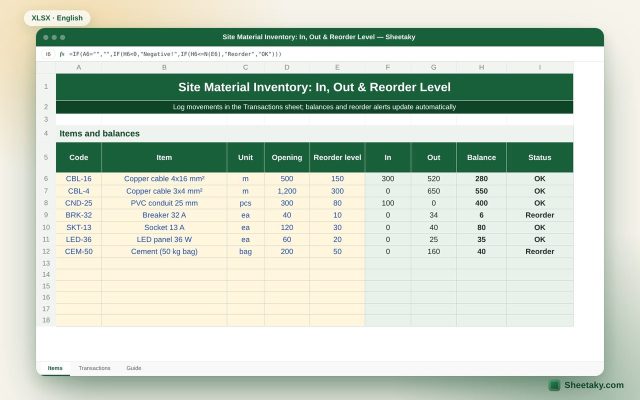
Site Material Inventory in Excel: In, Out, Balance & Reorder Level
An Excel sheet for site store stock: an items list and an IN/OUT log. It calculates current balances…
Engineering sheets
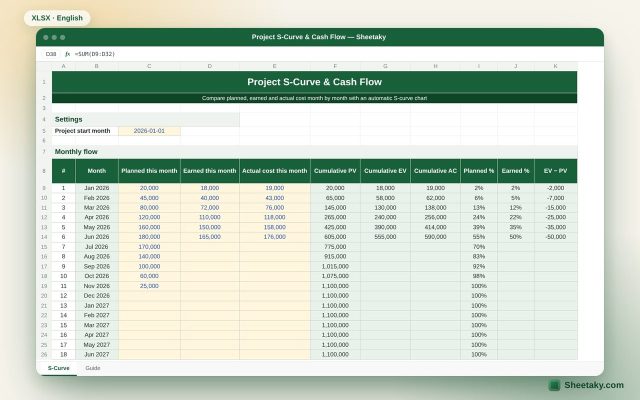
Project S-Curve & Cash Flow in Excel with Automatic Chart
An Excel sheet that draws the project S-curve from monthly planned, earned and actual cost, and calculates cumulative…
Engineering sheets
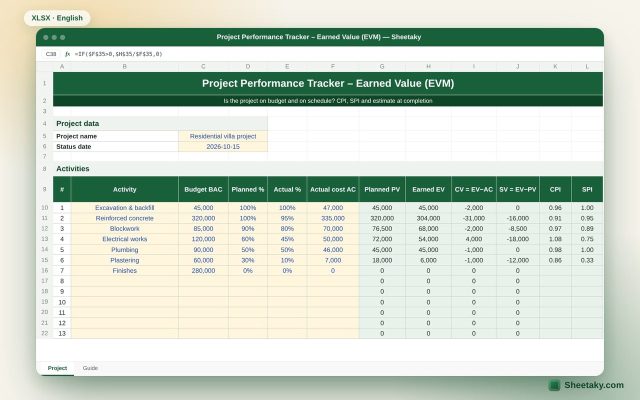
Earned Value Management (EVM) Tracker in Excel: CPI, SPI and EAC
An Excel sheet to measure project performance with earned value: PV, EV and AC per activity, CPI and…